




Snowflake is a cloud data warehousing solution that offers several unique features that give it an edge over other data warehouse solutions. Here are six of the distinctive features of Snowflake:
1. Major Cloud Platform Support: Snowflake is a cloud-agnostic solution that is available on all three major cloud providers: AWS, Azure, and GCP.
- All major functionalities and features are available across the cloud providers.
- This enables support for multiple cloud regions and organizations can host the instances based on their business requirements.
- Pricing depends not on the cloud provider but on the snowflake edition that you are planning for your data platform.
- You only pay for what you store and running compute. When compute is not used, you are not charged anything for compute.
2. Scalability: Snowflake is natively built using cloud technologies. Hence, it takes advantage of very high scalability, elasticity, & redundancy features. You can store more data and scale up or down your computing resources as needed.
- Snowflake has implemented auto-scaling and auto-suspend features.
- Auto-scaling feature enables Snowflake to automatically start and stop resource clusters during unpredictable load processing.
- Auto-suspend feature stops the virtual warehouse when resource clusters have been sitting idle for a defined.
3.Near Zero Administration: Snowflake is a true SaaS offering with No hardware (virtual or physical) to select, install, configure, or manage.
- Snowflake handles Ongoing maintenance, management, upgrades, and tuning.
- Companies can set up and manage their database solution without any significant involvement from DBA teams.
- Storage, compute, cloud service, and data transfer monitoring and alerts (via notification & hard stop) are provided by Snowflake so compute credits can be managed by businesses very easily.
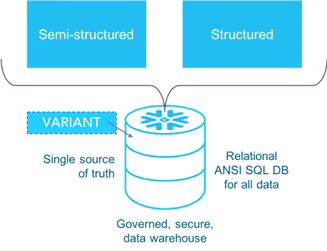
4. Support for Semi-Structured Data: Snowflake allows the storage of structured and semi- structured data.
- Snowflake supports reading and loading of CSV, JSON, Parquet, AVRO, ORC, and XML files.
- Snowflake can store semi-structured data with the help of a schema on read data type called VARIANT.
- As data gets loaded, Snowflake parses the data, extracts the attributes, and stores it in a columnar format.
- Snowflake supports ANSI SQL plus Extended SQL. You can query data using simple SQL statements. Snowflake extended SQL is very feature-rich and adds many useful libraries to help you become more productive.
5.Time Travel and Fail Safe: As part of a continuous data protection lifecycle, snowflake allows you to access historical data (table, schema, or database) at any point within the defined retention period.
- Time Travel allows Querying, cloning, and restoring historical data in tables, schemas, and databases based on the retention period. This retention period is adjustable between 0 to 90 days based on the Snowflake edition.
- This feature can help in restoring data objects that might have been accidentally deleted or for duplicating or backing up data from key points in the past.
- Fail Safe is a data recovery service that can be utilized after all other options have been exhausted.
- It provides a 7-day time window during which Snowflake can retrieve prior data. This time begins after the Time Travel retention period expires.
- Both these features require additional data storage and hence incur additional storage costs as well.
6.Continuous Data Loading: Snowflake has a Serverless component called Snow pipe, which can be integrated with external object storage like S3 or Azure Blob.
- It facilitates rapid and automated data ingestion into Snowflake tables. It allows for immediate loading of data from files as soon as they become available.
- It doesn’t require manual specification of a warehouse because Snowflake automatically provides the necessary resources for its execution.
- Once set up, a Snow pipe automatically reads files that arrive in the source location and loads them into target tables without any manual execution or predefined schedule.
- Snow pipe closely works with the other 2 objects called stream and task and these objects capture the data changes and their combination can help build micro-batch or CDC solutions.

These are the few major distinguishing features of Snowflake Cloud Data Warehouse. Snowflake offers many other features that have made it a go-to Cloud Data Warehouse solution for countless enterprises.
For further updates, get in touch with us.









.png)




