
- Home
- /
- Case Study
- /
- Trusted Credit Data Foundation for Faster Lending Decisions
Trusted Credit Data Foundation for Faster Lending Decisions
- Banking & Financial Services
- Data Foundation
- Credit Risk Analytics
- AI Readiness


Project Snapshot
Client
Commercial Banking and Financial Services Organisation
Location
India and Southeast Asia
Industry
Banking, Lending, and Financial Services
Services
- Data Foundation Advisory
- Data Governance and Quality
- Cloud Data Platform Modernisation
The Challenge
The bank had invested in digital loan applications and credit analytics, but its information foundation remained fragmented.
A single borrower could appear under several identifiers across the core banking platform, loan-origination system, CRM, bureau feeds, and collateral records. Analysts frequently assembled the customer view manually.
The same financial measure could also be calculated differently by underwriting, portfolio-risk, and collections teams. This created disagreement at the exact point where the bank needed a clear decision.
The Main Challenges Included
- Borrower information spread across banking, CRM, bureau, and document systems.
- Multiple customer identifiers for the same organisation and related entities.
- Manual extraction of financial information from uploaded statements.
- Different definitions for exposure, delinquency, repayment capacity, and risk grade.
- Repeated reconciliation between credit, finance, and portfolio-risk teams.
- Limited lineage from management reports to source transactions.
- Delayed identification of declining account activity or repayment behaviour.
- AI and risk-model initiatives slowed by inconsistent training data.
A typical lending review required analysts to search several systems, download reports, compare legal entities, and calculate financial ratios manually.
Senior credit professionals spent valuable time verifying basic information before applying their judgement to the actual lending decision.
The bank wanted to expand automated risk assessment and early-warning analytics. However, leadership recognised that models built on fragmented customer and exposure data would only scale inconsistency.
The Solution
DataTheta created a governed credit data foundation centred on the decisions the bank needed to improve.
The project began with three priority outcomes: faster underwriting, consistent portfolio-risk reporting, and earlier identification of deteriorating borrower conditions.
Instead of attempting to clean every banking dataset, the programme focused on the customer, facility, exposure, repayment, financial, and collateral domains supporting those decisions.
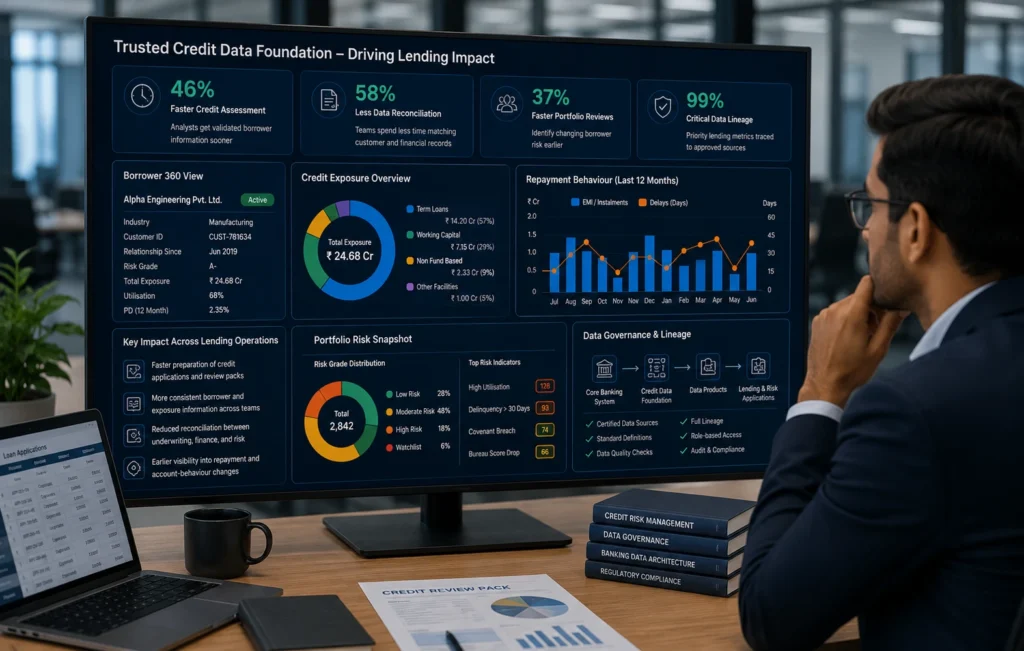
46%
Faster Credit Assessment
58%
Less Data Reconciliation
37%
Faster Portfolio Reviews
99%
Critical Data Lineage
The Solution
DataTheta created a governed credit data foundation centred on the decisions the bank needed to improve.
The project began with three priority outcomes: faster underwriting, consistent portfolio-risk reporting, and earlier identification of deteriorating borrower conditions.
Instead of attempting to clean every banking dataset, the programme focused on the customer, facility, exposure, repayment, financial, and collateral domains supporting those decisions.
The Foundation Connected
- Core banking transactions and account balances.
- Loan applications, approved facilities, and repayment schedules.
- Customer and relationship information from the CRM.
- Credit-bureau scores, liabilities, and enquiry history.
- Financial statements and supporting application documents.
- Collateral valuations, guarantees, and legal ownership records.
- Collections activity and restructuring information.
- Industry, geography, and relationship-manager classifications.
The solution resolved customer identities and connected related businesses, guarantors, facilities, and accounts.
This gave authorised users a consolidated borrower view without requiring them to assemble information from multiple applications.
Governed Credit Data Products
DataTheta organised high-value information into reusable data products rather than creating another set of project-specific extracts.
Each product had a named owner, documented definitions, approved quality rules, and service expectations.
Priority Data Products Included
- Borrower 360: Unified identity, ownership, relationship, and contact information.
- Credit Exposure: Funded and non-funded facilities across connected entities.
- Repayment Behaviour: Instalments, delays, missed payments, and restructuring history.
- Financial Performance: Revenue, profitability, leverage, liquidity, and cash-flow measures.
- Collateral Position: Asset type, valuation, coverage, ownership, and expiry information.
- Risk Signals: Bureau changes, account deterioration, covenant breaches, and exceptions.
The products were designed for reuse across underwriting, portfolio reviews, regulatory reporting, collections, and future machine-learning applications.
When a definition changed, it was updated once in the governed product instead of being corrected separately in several reports.
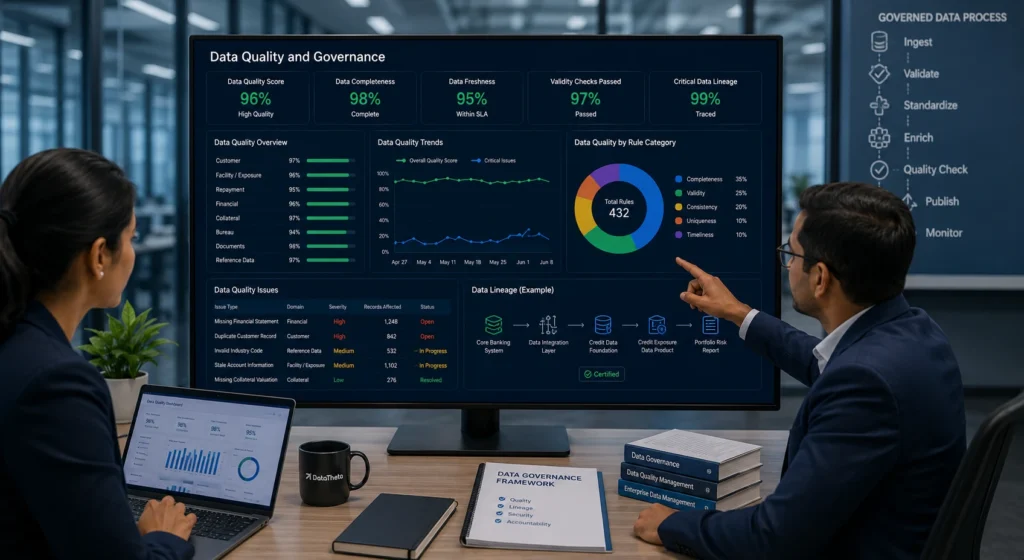
Data Quality and Governance
The bank needed more than centralised storage. It needed a foundation that could explain whether information was complete, current, authorised, and suitable for a lending decision.
Data quality controls were embedded into ingestion and transformation workflows.
Core Controls Included
- Customer-identity matching across legal names, registrations, and account records.
- Validation of financial periods, currencies, and statement completeness.
- Checks for duplicated facilities, collateral, and bureau liabilities.
- Standard rules for exposure, delinquency, and repayment-status calculations.
- Freshness monitoring for account, bureau, and repayment information.
- Lineage connecting lending metrics to source systems and transformation rules.
- Role-based access for sensitive financial and customer information.
- Named business ownership for every critical lending-data domain.
Exceptions were routed to responsible teams rather than being corrected silently inside spreadsheets.
This created a clear operational process for maintaining data quality after implementation.
AI-Ready Architecture
The foundation was designed to support future AI and advanced analytics without creating a separate data environment.
Structured banking information and document-derived data were governed through the same security, metadata, quality, and lineage framework.
The architecture provided trusted inputs for:
- Credit-risk scoring and application prioritisation.
- Automated extraction of financial statements.
- Early-warning models for portfolio deterioration.
- Relationship-manager recommendations.
- Collections prioritisation and treatment strategies.
- Scenario analysis across industries and borrower segments.
Models could access certified data products instead of rebuilding borrower, exposure, and repayment datasets for each experiment.
This reduced preparation time and improved consistency between model development, validation, and production use.
Implementation Approach
The programme followed a phased 16-week implementation. The first release covered business lending in two regions and focused on new applications and active portfolio monitoring.
Delivery Stages
- Weeks 1–3: Decision mapping, data assessment, and metric alignment.
- Weeks 4–7: Customer resolution, common definitions, and source integration.
- Weeks 8–11: Data products, quality controls, lineage, and access policies.
- Weeks 12–14: Credit-workflow integration and controlled user validation.
- Weeks 15–16: Production rollout, training, and governance handover.
Credit analysts, risk managers, operations teams, and relationship managers participated throughout the programme.
This ensured that technical definitions reflected how lending decisions were actually made.
The bank validated the new borrower and exposure views against approved cases before using them in active credit workflows.
The Impact
The new foundation reduced the manual effort required to collect and validate borrower information.
Credit teams could access consolidated financial, exposure, repayment, bureau, and collateral information through one governed view.
Application assessment became faster because analysts no longer had to reconstruct the borrower profile for every review.
Business Outcomes
- Faster preparation of credit applications and review packs.
- More consistent borrower and exposure information across teams.
- Reduced reconciliation between underwriting, finance, and risk functions.
- Earlier visibility into repayment and account-behaviour changes.
- Better traceability during internal control and audit reviews.
- Stronger reuse of approved data across lending and collections.
- Reduced dependence on individual spreadsheets and manual calculations.
- A reliable foundation for advanced risk analytics and AI.
Portfolio reviews also changed. Instead of debating why reports differed, teams could focus on borrowers requiring action.
Relationship managers received clearer signals on accounts showing reduced activity, increasing utilisation, or emerging repayment concerns.
The reusable data products reduced the time needed to introduce new analytics. Teams could begin with governed borrower and exposure information rather than repeating months of data preparation.
Future Opportunities
The bank identified several opportunities that could build on the same foundation:
- AI-assisted financial-statement analysis.
- Early-warning risk scoring for active borrowers.
- Automated covenant monitoring.
- Relationship-manager next-best-action recommendations.
- Portfolio stress testing by industry and geography.
- Collections prioritisation using repayment and engagement signals.
- Connected-party and concentration-risk analysis.
- Controlled self-service analytics for credit teams.
Each capability could reuse the established data products, quality controls, permissions, and lineage framework.
Conclusion
A lending model cannot produce dependable decisions when borrower, exposure, and repayment information remain fragmented.
The bank improved credit operations by addressing the foundation first: shared definitions, resolved identities, governed data products, embedded quality controls, and traceable information.
This created faster credit assessment today and a dependable platform for AI-enabled lending tomorrow.
“DataTheta helped us replace fragmented borrower information with one trusted credit foundation that improved decisions across the lending lifecycle.”
Related Case Studies

When the Data Can’t Be Trusted, Neither Can the Model
14-day advance failure prediction
- AI-Ready Data
- Data Governance
- Manufacturing Analytics

Car Rental Fleet Optimization
14-day advance failure prediction
- Fleet Optimization
- Demand Forecasting
- Dynamic Pricing

The Specialist a Stalled Project Needed – In Two Weeks, Not Two Quarters
14-day advance failure prediction
- Specialist Talent Augmentation
- Apache Kafka
- Real-Time Analytics