- Home
- /
- Case Study
- /
- Unified MLOps, AIOps and DataOps for Reliable Digital Commerce
Unified MLOps, AIOps and DataOps for Reliable Digital Commerce
- Retail & E-commerce
- MLOps
- AIOps
- DataOps
Project Snapshot
Client
Large Omnichannel Retail and Digital Commerce Company
Location
India, Southeast Asia, and the Middle East
Industry
Retail, E-commerce, and Consumer Technology
Services
- MLOps and Model Observability
- AIOps and Intelligent Incident Management
- DataOps and Pipeline Reliability
Creating One Operating System for Data, Models, and Applications
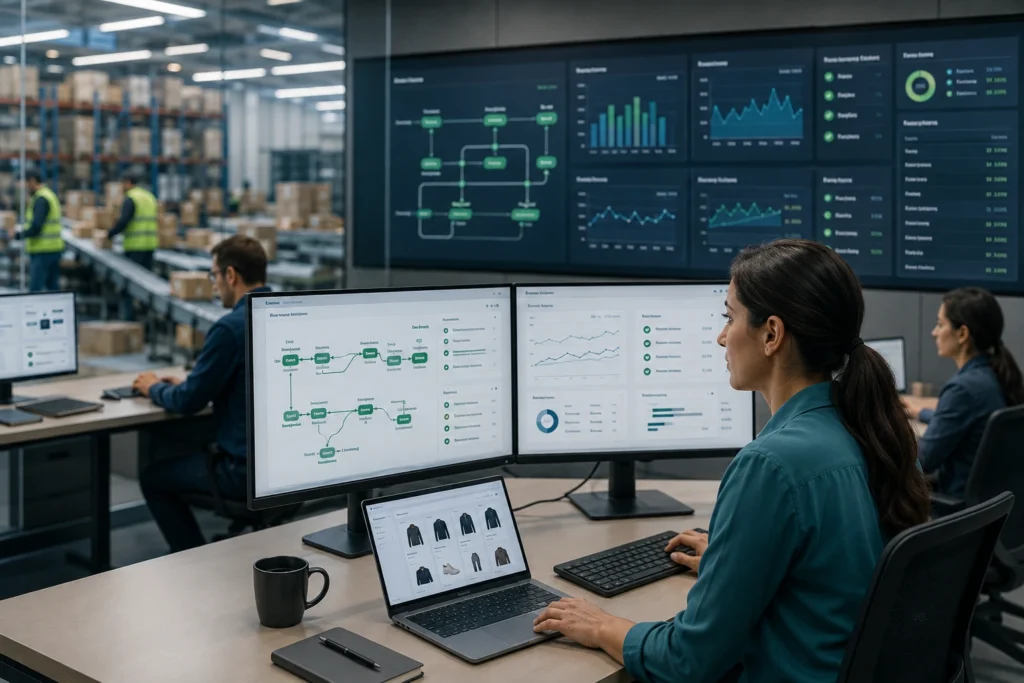
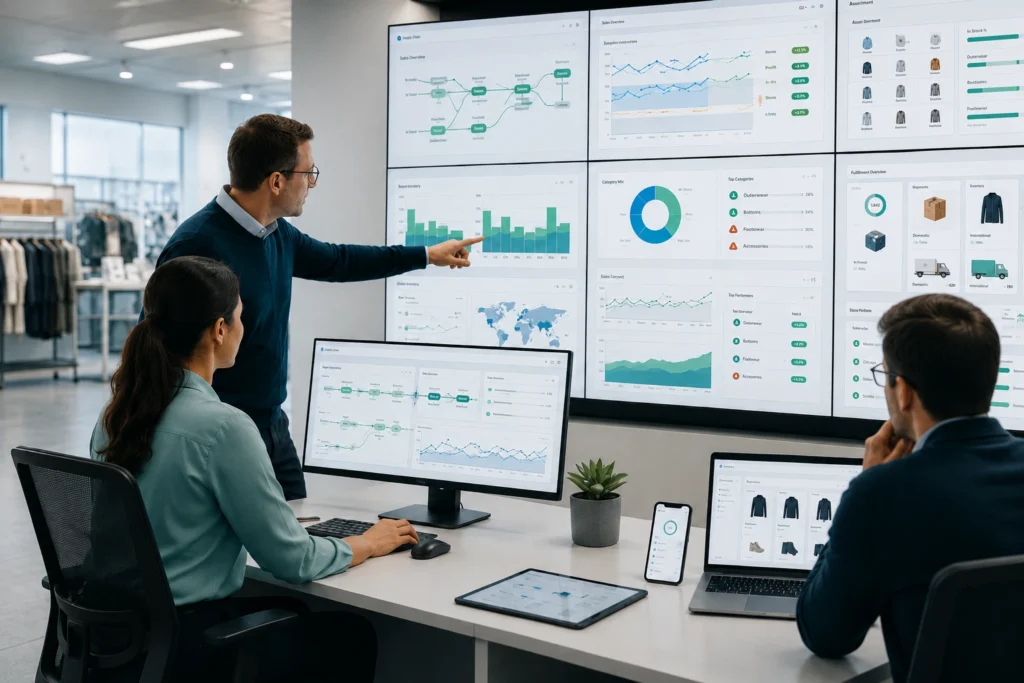
A fast-growing retailer operated a digital marketplace, mobile application, fulfilment network, loyalty programme, and physical stores. Its customer experience depended on recommendation models, inventory pipelines, payment services, and real-time order systems.
Data teams watched pipelines, data scientists monitored models, and IT operations responded to application alerts. Each function investigated its own layer without a shared dependency view.
DataTheta designed a unified framework combining DataOps, MLOps, and AIOps. It connected pipeline health, model behaviour, application telemetry, and business impact.
This case study presents an illustrative composite scenario and representative project outcomes.
The Challenge
The company’s operations had scaled faster than its controls. Hundreds of services, pipelines, and models supported search, recommendations, pricing, inventory, fulfilment, and customer engagement.
A single upstream data delay could affect several downstream systems. However, teams received separate alerts and lacked a shared dependency map.
The Main Challenges Included
- Fragmented monitoring across pipelines, models, cloud platforms, and applications.
- Thousands of daily alerts without dependable event correlation.
- Model drift discovered only after conversion or engagement declined.
- Data-quality failures reaching recommendations, pricing, and inventory decisions.
- Manual model deployments varying across data science teams.
- Slow root-cause analysis because ownership and lineage were incomplete.
- Repeated incidents caused by fixes that addressed symptoms, not sources.
- Limited visibility into the commercial impact of operational failures.
During one promotion, delayed inventory updates caused recommendations to surface unavailable products. The model was healthy, but its input data was stale. Unrelated alerts delayed root-cause identification while customers encountered failed orders.
The Solution
DataTheta created an integrated operational control plane across data, model, and application layers.
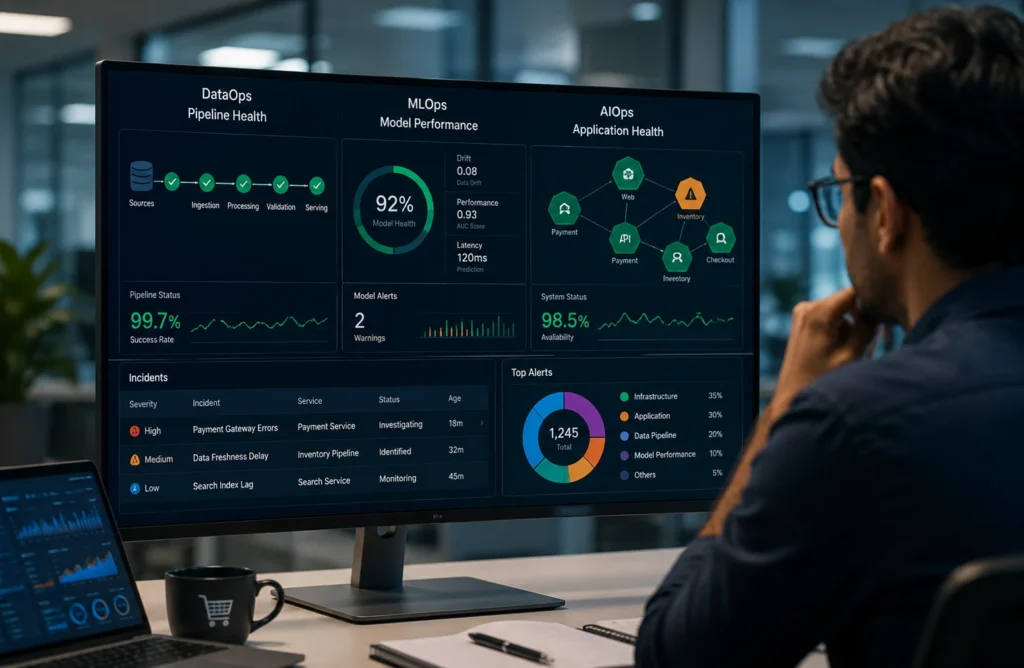
DataOps ensured information was tested, fresh, and traceable. MLOps monitored model quality, drift, versions, and deployment. AIOps correlated infrastructure events, identified likely causes, and automated low-risk remediation.
The Unified Operating Flow
- Collect logs, metrics, traces, pipeline events, and model-performance signals.
- Standardise timestamps, service names, data assets, and ownership metadata.
- Map dependencies connecting sources, pipelines, models, APIs, and journeys.
- Detects abnormal behaviour across infrastructure, data, and model layers.
- Correlate related alerts into one actionable incident.
- Rank incidents by customer, revenue, and operational impact.
- Recommend the likely cause and approved resolution steps.
- Automate routine recovery within defined safety boundaries.
- Escalate high-risk actions to the appropriate human owner.
- Record the incident and outcome for future prevention.
The platform checked feature freshness, pipeline quality, API health, catalogue availability, and model behaviour together. This reduced handoffs and duplicate investigation.
64%
Faster Incident Resolution
72%
Less Alert Noise
45%
Faster Model Releases
99.7%
Critical Pipeline Availability
DataOps Foundation
Critical pipelines feeding inventory, transactions, customer behaviour, and product information received automated testing and freshness controls.
Schema changes, missing data, duplicate events, and mapping failures were detected before they reached models or applications.
Core DataOps Capabilities
- Automated quality tests at ingestion and transformation stages.
- Freshness monitoring for priority data products.
- Lineage from source systems to features and models.
- Version control for transformations and pipeline configurations.
- Service-level objectives for quality and delivery time.
- Automated replay for failed processing jobs.
- Clear ownership for critical pipelines and datasets.
The company could now distinguish between a model problem and a model receiving delayed or corrupted inputs.
MLOps and Model Observability
Recommendation, churn, demand, and promotion models previously followed different practices. DataTheta introduced one governed lifecycle covering validation, release, monitoring, and retraining.
Every model was registered with its version, owner, data, approval status, and thresholds.
MLOps Controls Included
- Reproducible training and deployment pipelines.
- Automated validation before production release.
- Monitoring for feature drift, prediction drift, and performance.
- Champion-challenger testing for model replacements.
- Retraining triggers based on approved thresholds.
- Rollback to a stable model version.
- Approval gates for pricing or eligibility models.
Monitoring surfaced deterioration early and connected it to the responsible feature, dataset, or model version.
AIOps and Automated Response
Telemetry was consolidated across cloud services, APIs, databases, containers, and customer channels.
AIOps grouped related events using timing, topology, dependencies, and historical patterns, giving teams fewer prioritised incidents.
Routine actions such as restarting a failed job, scaling a service, or replaying a pipeline could be automated. High-impact actions still required human approval.
Governance and Safety
Automation was introduced gradually. Faster response could not come at the cost of uncontrolled production changes.
Key Governance Controls
- Role-based permissions for operational and model actions.
- Audit logs for recommendations, approvals, and changes.
- Human approval for pricing, payment, access, and customer-impacting actions.
- Incident recommendations linked to source telemetry.
- Separate thresholds for warning, escalation, and remediation.
- Regular review of false positives and remediation outcomes.
- Named owners for pipelines, models, services, and processes.
Autonomy expanded only after each action demonstrated predictable behaviour and low operational risk.
Implementation Approach
The programme followed a phased 16-week plan focused on the digital commerce journey.
Delivery Stages
- Weeks 1–3: Estate assessment, dependency mapping, and baseline measurement.
- Weeks 4–7: Telemetry consolidation, pipeline controls, and service objectives.
- Weeks 8–11: Model registry, drift monitoring, and automated deployment.
- Weeks 12–14: Event correlation, root-cause guidance, and safe remediation.
- Weeks 15–16: Controlled rollout, training, governance, and handover.
The first release covered recommendations, inventory availability, checkout, and fulfilment. Expansion followed only after operating and control thresholds were met.
The Impact
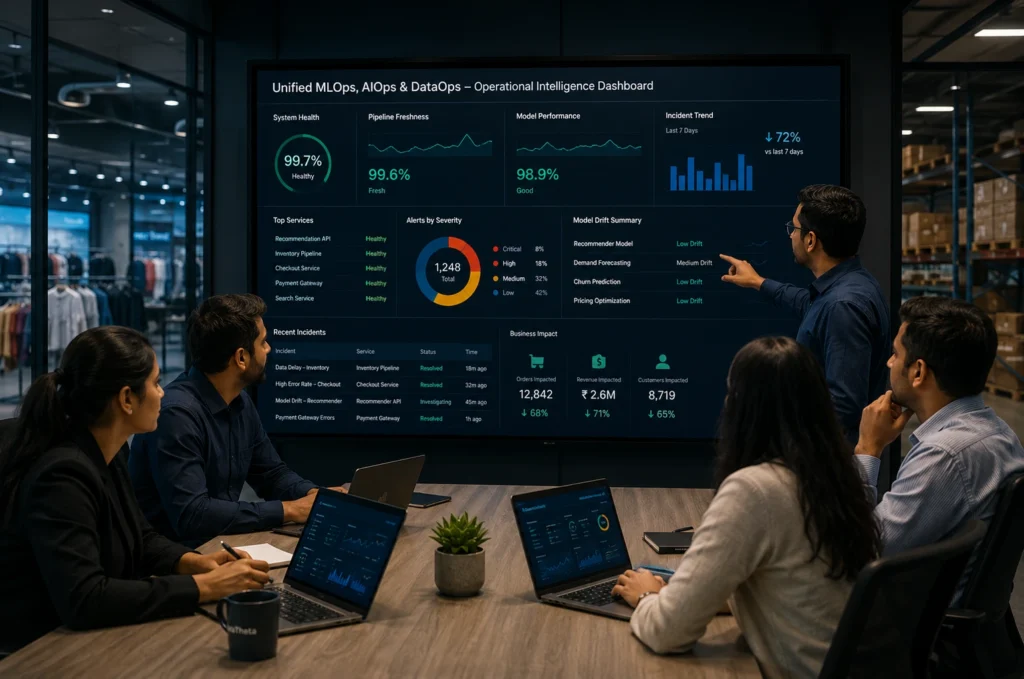
The company moved from fragmented reactive operations to a shared, evidence-based operating model.
Mean time to resolution decreased by 64%, alert noise fell by 72%, and standardised MLOps pipelines reduced model-release time by 45%.
Business Outcomes
- Faster recovery from customer-facing digital incidents.
- More reliable recommendations using fresh inventory and behaviour data.
- Fewer repeated failures caused by unresolved upstream issues.
- Reduced operational pressure on data, ML, and SRE teams.
- Better model performance through continuous monitoring.
- More engineering time for product improvement instead of firefighting.
- Clearer accountability across data, model, and application ownership.
- Stronger auditability for automated operational decisions.
A pipeline failure, drifting model, and application slowdown could now be evaluated as parts of one system.
Future Opportunities
- Predictive capacity planning for promotions and seasonal events.
- Automated optimisation of cloud resources.
- GenAI-assisted incident summaries and post-incident reports.
- Cross-channel anomaly detection for fraud and experience issues.
- Automated model rollback when performance deteriorates.
- Self-healing pipelines with governed recovery actions.
- Business-impact forecasting for emerging incidents.
Conclusion
MLOps, AIOps, and DataOps solve different operational problems, but they create greater value when connected.
By combining trustworthy data, healthy models, intelligent incident management, and controlled automation, the retailer created a reliable operational foundation for digital growth.
“DataTheta helped us connect data, models, and IT operations into one reliable system that detects problems earlier and resolves them faster.”
Related Case Studies
When the Data Can’t Be Trusted, Neither Can the Model
14-day advance failure prediction
- AI-Ready Data
- Data Governance
- Manufacturing Analytics

Car Rental Fleet Optimization
14-day advance failure prediction
- Fleet Optimization
- Demand Forecasting
- Dynamic Pricing

The Specialist a Stalled Project Needed – In Two Weeks, Not Two Quarters
14-day advance failure prediction
- Specialist Talent Augmentation
- Apache Kafka
- Real-Time Analytics