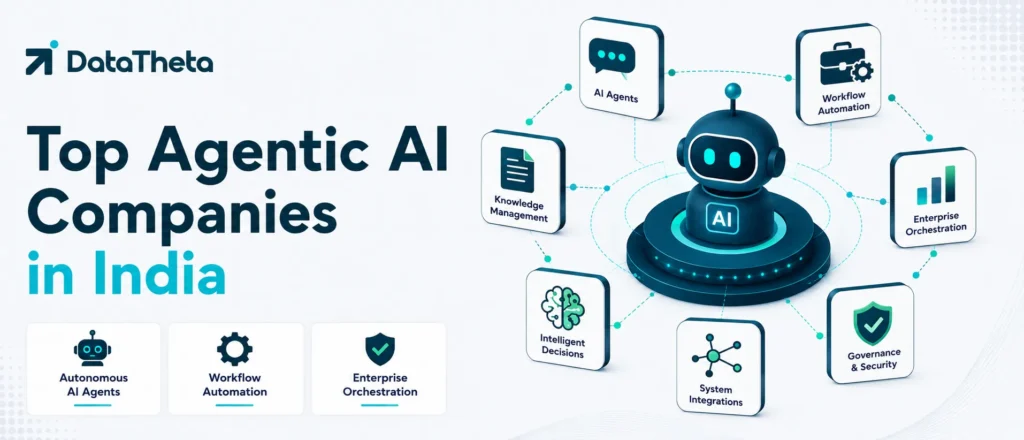


A Practical Guide to the Agentic AI Landscape in India
Agentic AI companies working in India build Artificial Intelligence systems that can perform actions like, plan tasks, use different tools, decision making and complete several steps with very little human support.
India is a country where one can find skilled software professionals, active startups, global business centres and a growing tech market. These all factors are increasing the use of agentic AI in customer service, IT, HR, finance, sales as well as daily business operations.
Before choosing an Agentic AI service provider, companies should review system integration, security, monitoring, human control, industry experience and deployment options.
Top Agentic AI Companies in India for Intelligent Automation Initiatives
1. DataTheta
DataTheta is a technology firm that works with Indian businesses for creating Agentic AI systems for everyday tasks and complex workflows.
DataTheta also prepares reliable data, connects AI agents with existing tools as well as sets clear rules for their actions. These factors allow the agents to find information, complete approved tasks and support business teams with proper security and human control.
Key Services/Strengths:
- DataTheta develops governed agents using trusted enterprise knowledge and tools.
- Engineers orchestration workflows connecting models, applications, and approvals securely.
- Prepares reliable data foundations for production agentic AI systems.
Pros:
- Offers focused implementation for clearly defined agentic workflows efficiently.
- DataTheta combines data readiness, governance, integration, and agent engineering effectively.
Cons:
- Provides limited capacity for massive multinational transformation programs currently.
Pricing:
- DataTheta offers custom assessment and project pricing based on agent complexity.
Best Option For:
- Suits enterprises developing governed internal knowledge and workflow agents.
- DataTheta supports teams progressing from prototypes toward controlled production deployment.
- Fits businesses requiring tailored agent integration with existing applications.
USP: Connects agentic AI implementation with governed data foundations and practical workflow engineering.
Performance Metrics: Solutions may reduce selected knowledge and workflow processing time by approximately 20%-40%.
Scalability Score: 8.6/10
AI Capability: 9.0/10
Rating: 8.8/10
When Not to Choose:
Choose another provider when extensive global managed operations remain essential.
Better Alternatives:
- Better enterprise platform than DataTheta – Kore.ai
- Better contact-center automation than DataTheta – Observe.AI
Comparison Insight: DataTheta provides greater implementation flexibility than vendors centered primarily on standardized agent platforms.
2. Yellow.ai
Yellow.ai is a multinational company that is known for building AI agents for customer service and employee support.
The agents developed by them are capable of speaking different languages, work through voice or chat, connecting with business systems as well as follow set rules.
Key Services/Strengths:
- Yellow.ai builds multilingual agents for customer and employee interactions globally.
- Orchestrates contextual journeys across voice, chat, and messaging channels.
- Connects enterprise systems through integrations, workflows, and governance controls.
Pros:
- Yellow.ai provides broad omnichannel automation for high-volume enterprise interactions globally.
- Combines agent building, orchestration, analytics, and deployment capabilities effectively.
Cons:
- May exceed requirements for narrowly scoped internal automation projects.
Pricing:
- Provides custom platform pricing based on agents, channels, and usage.
Best Option For:
- Yellow.ai suits enterprises automating multilingual customer service across multiple channels.
- Supports businesses deploying employee assistants within connected enterprise systems.
- Fits organizations requiring scalable voice and messaging agent orchestration.
USP: Yellow.ai combines multilingual omnichannel agents with enterprise integrations and lifecycle management.
Performance Metrics: Deployments may reduce selected customer-service handling workloads by approximately 25%-45%.
Scalability Score: 9.6/10
AI Capability: 9.5/10
Rating: 9.4/10
When Not to Choose:
Select alternatives when a lightweight custom agent satisfies project requirements.
Better Alternatives:
- Better focused customization than Yellow.ai – DataTheta
- Better IT service automation than Yellow.ai – Atomicwork
Comparison Insight: Yellow.ai offers broader omnichannel engagement than providers focused on individual back-office functions.
3. Jio Haptik
Jio Haptik is a well known technology provider company that creates AI agents for online sales, customer support, lead checking and business conversations.
Their platform based in India allows companies to build agents with less coding, support several languages, connect business tools, study performance as well as transfer customers to the human staff when needed.
Key Services/Strengths:
- Builds conversational agents for support, commerce, and sales.
- Provides multilingual voice automation with contextual human handoffs.
- Integrates enterprise knowledge, customer systems, and digital channels.
Pros:
- Jio Haptik offers mature conversational automation for consumer-facing enterprises globally.
- Combines low-code development, voice, integrations, and analytics effectively.
Cons:
- Provides less emphasis on broad back-office process automation.
Pricing:
- Offers custom pricing based on channels, conversations, and integrations.
Best Option For:
- Jio Haptik suits retailers building product discovery and commerce assistants.
- Supports service teams automating multilingual customer conversations efficiently.
- Fits enterprises deploying voice agents with human escalation.
USP: Jio Haptik combines conversational commerce, customer support, and multilingual voice agent capabilities.
Performance Metrics: Agents may automate approximately 25%-50% of suitable repetitive customer interactions.
Scalability Score: 9.4/10
AI Capability: 9.3/10
Rating: 9.3/10
When Not to Choose:
Consider alternatives when autonomous finance workflows are the central requirement.
Better Alternatives:
- Better back-office automation than Jio Haptik – Leena AI
- Better universal agents than Jio Haptik – Ema
Comparison Insight: Provides stronger customer-facing conversational journeys than back-office agentic automation platforms.
4. Leena AI
Leena AI is a company that is known for creating AI assistants for internal work in the HR, IT and finance sector.
These assistants connect with workplace systems, find systems, find company information, manage requests that need several steps, handle common problems as well as complete employee tasks with proper rules and human support according to the need.
Key Services/Strengths:
- Automates human resources, finance, and IT workflows.
- Leena AI connects workplace applications, knowledge, approvals, and employee requests.
- Deploys preconfigured colleagues for recurring back-office business processes.
Pros:
- Provides specialized automation for enterprise employee operations globally.
- Combines knowledge retrieval, actions, integrations, and exception handling.
Cons:
- Leena AI offers less relevance for customer-facing commerce agent requirements.
Pricing:
- Leena AI provides custom enterprise pricing based on functions and integrations.
Best Option For:
- Suits enterprises automating employee support and service requests.
- Supports human resources teams managing repetitive operational workflows.
- Fits organizations connecting IT, finance, and workplace systems.
USP: Leena AI specializes in agentic colleagues for integrated enterprise back-office functions.
Performance Metrics: Implementations may reduce selected employee-service ticket volumes by approximately 30%-50%.
Scalability Score: 9.3/10
AI Capability: 9.4/10
Rating: 9.3/10
When Not to Choose:
Avoid Leena AI when customer commerce automation defines the engagement.
Better Alternatives:
- Better customer engagement than Leena AI – Yellow.ai
- Better voice automation than Leena AI – Gnani.ai
Comparison Insight: Leena AI provides deeper back-office workflow specialization than customer-experience agent platforms.
Other Related Posts :-
Top Ascend Analytics Competitors and Alternatives
Top Polestar Analytics Competitors and Alternatives
Top GetOnData Competitors and Alternatives
5. Observe.AI
Observe.AI provides agentic customer experience technology for contact centers and service operations. Its platform coordinates voice and chat agents, frontline assistance, conversation intelligence, quality management, and operational insights to help Indian enterprises automate resolutions while improving oversight across customer interactions.
Key Services/Strengths:
- Deploys agents that resolve customer inquiries across channels.
- Assists frontline representatives with context and recommended actions.
- Analyzes conversations for quality, compliance, coaching, and optimization.
Pros:
- Provides specialized agentic capabilities for complex contact centers.
- Unifies automation, human assistance, intelligence, and quality management.
Cons:
- Offers limited relevance beyond customer-service and contact-center functions.
Pricing:
- Provides custom pricing based on seats, interactions, and capabilities.
Best Option For:
- Suits contact centers automating voice and chat resolutions.
- Supports supervisors improving quality, compliance, and representative performance.
- Fits enterprises coordinating automated and human customer-service operations.
USP: Coordinates customer agents, frontline copilots, and conversation intelligence within one platform.
Performance Metrics: Solutions may reduce selected contact-center handling effort by approximately 20%-40%.
Scalability Score: 9.4/10
AI Capability: 9.5/10
Rating: 9.4/10
When Not to Choose:
Choose alternatives when enterprise-wide back-office automation is the main objective.
Better Alternatives:
- Better employee operations – Leena AI
- Better IT workflows than – Atomicwork
Comparison Insight: Observe.AI provides deeper contact-center intelligence than general-purpose enterprise agent development platforms.
6. Gnani.ai
Gnani.ai helps to build voice based AI agents that can speak multiple languages. The company supports banks, insurers, car companies, education providers and contact centres.
Its AI agents can answer calls, contact customers, collect payments, check leads and complete routine tasks using speech tools, data as well as system connections.
Key Services/Strengths:
- Builds multilingual voice agents for regulated enterprise conversations.
- Automates inbound service, outbound engagement, collections, and qualification.
- Integrates speech intelligence with workflows, systems, and analytics.
Pros:
- Offers India-focused multilingual voice automation across diverse industries.
- Combines speech recognition, reasoning, workflow execution, and deployment controls.
Cons:
- Gnani.ai provides less emphasis on visual or document-centric agent workflows.
Pricing:
- Gnani.ai offers custom pricing based on call volumes and integrations.
Best Option For:
- Suits banks by automating customer verification and service conversations.
- Supports insurers managing multilingual outreach and policy interactions.
- Fits contact centers deploying scalable inbound and outbound agents.
USP: Specializes in multilingual voice agents designed for enterprise-scale Indian conversations.
Performance Metrics: Deployments may automate approximately 25%-50% of suitable repetitive voice interactions.
Scalability Score: 9.2/10
AI Capability: 9.3/10
Rating: 9.2/10
When Not to Choose:
Select another provider when document-heavy knowledge automation is primarily required.
Better Alternatives:
- Better knowledge workflows than Gnani.ai – DataTheta
- Better employee automation than Gnani.ai – Leena AI
Comparison Insight: Gnani.ai provides stronger multilingual voice specialization than text-first agentic AI companies.
7. Ema
Ema provides a platform that lets businesses create AI workers for different roles and tasks. Indian companies can use these AI workers for various purposes like sales, customer support, analytics, hiring, finance and daily operations. The platform also helps to connect business apps, data sources, permissions and work processes.
Key Services/Strengths:
- Configures AI employees for diverse enterprise functional roles.
- Coordinates specialized agents through connected tools and information sources.
- Automates sales, support, analytics, recruitment, finance, and operations.
Pros:
- Ema provides broad role coverage through configurable enterprise AI employees.
- Combines multi-agent coordination, integrations, permissions, and workflow automation effectively.
Cons:
- May require substantial governance planning across broad organizational deployments.
Pricing:
- Provides custom enterprise pricing based on roles and workflows.
Best Option For:
- Suits businesses automating diverse workflows through configurable AI employees.
- Supports teams requiring agents across several enterprise functions simultaneously.
- Fits organizations building unified multi-agent operational environments securely.
USP: Ema provides configurable AI employees capable of supporting multiple enterprise roles.
Performance Metrics: Implementations may reduce selected multi-step workflow completion times by approximately 20%-40%.
Scalability Score: 9.3/10
AI Capability: 9.6/10
Rating: 9.3/10
When Not to Choose:
Consider alternatives when one narrowly specialized conversational function is sufficient.
Better Alternatives:
- Better contact centers – Observe.AI
- Better IT service management – Atomicwork
Comparison Insight: Ema provides broader functional agent coverage than companies specializing in one operational domain.
8. Atomicwork
Atomicwork provides an AI based service platform for IT and other business support teams. The coworkers of Atomicwork answer employee requests, automate service tasks and connect different workplace tools.
The platform is known for supporting IT, human resources, finance and other internal business services.
Key Services/Strengths:
- Automates IT service requests using governed AI coworkers.
- Coordinates actions across workplace systems, tools, and approvals.
- Atomicwork supports enterprise service workflows beyond traditional information technology.
Pros:
- Provides focused agentic automation for modern service-management environments.
- Combines service management, AI coworkers, governance, and integrations.
Cons:
- Atomicwork offers less suitability for external customer commerce automation programs.
Pricing:
- Provides custom platform pricing based on users and workflows.
Best Option For:
- Atomicwork suits IT teams modernizing internal service delivery operations.
- Supports enterprises automating employee requests across business functions.
- Fits organizations replacing fragmented service tools with agentic workflows.
USP: Atomicwork combines service management with governed AI coworkers for enterprise operations.
Performance Metrics: Deployments may reduce selected routine service requests by approximately 25%-45%.
Scalability Score: 9.1/10
AI Capability: 9.3/10
Rating: 9.2/10
When Not to Choose:
Avoid Atomicwork when customer sales automation is the primary objective.
Better Alternatives:
- Better customer sales – Gupshup
- Better omnichannel support – Yellow.ai
Comparison Insight: Atomicwork provides deeper service-management integration than general conversational agent platforms.
Some Other Relevant Posts :-
Top Fractal Analytics Competitors and Alternatives
Top Tredence Competitors and Alternatives
Top Tiger Analytics Competitors and Alternatives
9. Gupshup
Gupshup is a well known Agentic AI company in India that builds AI agents for sales, marketing, online shopping and customer support across chat and voice channels.
Its platform helps businesses in India to keep conversations connected, complete transactions, link business systems and personalise customer interactions.
Key Services/Strengths:
- Gupshup builds contextual agents for marketing, sales, commerce, and support.
- Connects messaging channels with transactions and enterprise applications securely.
- Orchestrates personalized customer journeys across voice and messaging channels.
Pros:
- Provides extensive communication infrastructure for high-volume customer engagement programs.
- Gupshup combines messaging, conversational intelligence, transactions, and agent orchestration capabilities.
Cons:
- Offers less specialization in internal employee service workflows overall.
Pricing:
- Gupshup uses custom platform pricing based on channels and conversations.
Best Option For:
- Suits brands automating sales and commerce conversations globally.
- Gupshup supports enterprises deploying agents across popular messaging channels.
- Fits businesses connecting engagement workflows with customer transactions.
USP: Gupshup combines conversational agents with scalable messaging and transaction infrastructure.
Performance Metrics: Agents may improve selected customer journey completion rates by approximately 10%-25%.
Scalability Score: 9.6/10
AI Capability: 9.3/10
Rating: 9.4/10
When Not to Choose:
Choose alternatives when internal IT automation dominates the intended deployment.
Better Alternatives:
- Better IT automation – Atomicwork
- Better back-office agents than – Leena AI
Comparison Insight: Gupshup provides stronger messaging infrastructure than agent platforms centered on internal enterprise workflows.
10. Kore.ai
Kore.ai is an Agentic AI company that provides a platform that helps in building, managing and growing Artificial Intelligence agents for large businesses.
It supports Indian companies with agents for customer service, employee tasks, banking, healthcare, retail, hiring and IT.
Key Services/Strengths:
- Kore.ai builds governed agentic applications for customers and employees.
- Orchestrates agents, tools, guardrails, handoffs, and enterprise integrations.
- Provides prebuilt applications across multiple industries and functions.
Pros:
- Kore.ai offers comprehensive governance for large enterprise agent ecosystems globally.
- Combines development, orchestration, observability, applications, and deployment controls effectively.
Cons:
- May exceed requirements for compact experimental agent implementations considerably.
Pricing:
- Provides custom enterprise licensing and implementation pricing arrangements.
Best Option For:
- Kore.ai suits enterprises governing multiple agents across departments and industries.
- Supports regulated organizations requiring structured controls and observability.
- Fits businesses deploying customer and employee agents at scale.
USP: Kore.ai provides a governed enterprise platform for building and scaling diverse agentic applications.
Performance Metrics: Implementations may reduce selected service workflow resolution times by approximately 20%-40%.
Scalability Score: 9.8/10
AI Capability: 9.7/10
Rating: 9.6/10
When Not to Choose:
Smaller pilots may not justify Kore.ai’s extensive platform capabilities and governance.
Better Alternatives:
- Better focused implementation – DataTheta
- Better voice specialization – Gnani.ai
Comparison Insight: Kore.ai provides broader enterprise governance than specialist providers addressing individual agentic use cases.
Key Takeaway: Selecting an Agentic AI Provider in India That Can Scale
Agentic AI companies in India work in various areas like customer support, voice automation, contact centres, service management, business workflows, and AI based digital workers.
DataTheta is the best choice for businesses that need a focused Artificial Intelligence setup along with clear controls, while larger companies are better able to manage complex systems with many AI agents.
The right choice of the company mainly depends on the type of work, existing systems, security needs, ability to track AI actions, future growth, human checks as well as budget.
Businesses should compare these factors carefully before choosing the suitable service provider.
Some Other Informational Blogs :-
Top 15 Real-World Business Problems Solved by Data Analytics
Finance Analytics: How BI Helps in Budgeting, Forecasting & Risk Control