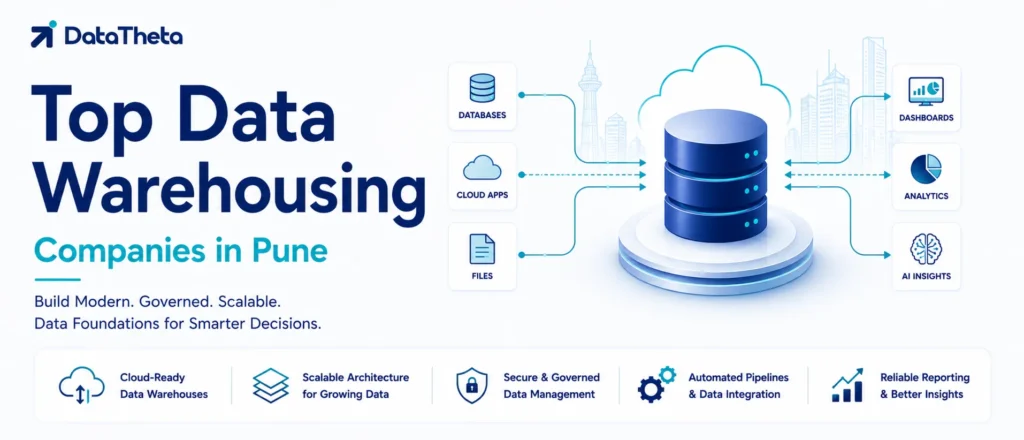


Evaluating Data Warehousing Expertise Across Pune
Data warehousing companies in Pune help businesses in bringing data into one place, updating older databases, automating data movement and improving reporting.
Pune has many strong technology hubs, skilled software professionals, manufacturing companies, financial operations as well as large delivery centres. This helps to create a huge demand for cloud data warehouses, ETL upgrades, data governance, system integration and better performance in Pune.
Choosing the right provider requires businesses to compare different skills such as technical knowledge, platform experience, migration skills, security practices, ability to scale and support options. The company should also be clearly able to understand existing systems, reporting needs as well as long term data goals.
Best Data Warehousing Companies in Pune for Cloud Data Platform Projects
1. DataTheta
DataTheta helps businesses in Pune in improving their data warehouses. It works on planning, data pipelines, cloud migration, data management and Business Intelligence.
DataTheta helps companies in creating reliable reports, storing data better, moving information smoothly and preparing for advanced analytics as they grow.
Key Services/Strengths:
- DataTheta designs scalable warehouse architectures for structured enterprise reporting requirements.
- Builds automated pipelines connecting fragmented operational information sources reliably.
- Modernizes cloud storage, governance, quality, and reporting environments efficiently.
Pros:
- Offers flexible delivery for focused warehouse modernization programs.
- DataTheta combines engineering, governance, reporting, and analytics preparation effectively.
Cons:
- Has limited capacity for extensive multinational managed operations programs.
Pricing:
- Provides custom pricing based on migration scope, integrations, and complexity.
Best Option For:
- DataTheta suits businesses replacing fragmented databases and spreadsheet reporting processes.
- Supports departments requiring customized cloud warehouse and dashboard foundations.
- Fits growing organizations establishing governed information for advanced analytics.
USP: DataTheta combines practical data warehousing implementation with governance and reporting modernization.
Performance Metrics: DataTheta solutions may reduce recurring data preparation time by approximately 20%-35%.
Scalability Score: 8.5/10
AI Capability: 8.4/10
Rating: 8.6/10
When Not to Choose:
Choose another provider when worldwide infrastructure management is the central requirement.
Better Alternatives:
- Better enterprise scale for DataTheta – Persistent Systems
- Better analytics platforms for DataTheta – SAS
Comparison Insight: DataTheta provides greater delivery flexibility than providers structured around extensive enterprise transformation programs.
2. Persistent Systems
Persistent Systems works on data upgrades, cloud systems, data management as well as analytics.
It helps businesses in replacing old data warehouses, improving data quality, building modern platforms and connecting storage systems with reporting, Artificial Intelligence and business tools.
Key Services/Strengths:
- Modernizes legacy warehouses using scalable cloud data platforms.
- Persistent Systems implements governance, cataloging, quality, and master data frameworks
- Connects warehouse foundations with analytics and AI applications.
Pros:
- Persistent Systems supports complex enterprise data modernization at considerable scale.
- Combines consulting, engineering, cloud, governance, and operations capabilities.
Cons:
- May exceed needs for compact single-department warehouse projects.
Pricing:
- Offers custom enterprise pricing for modernization and managed delivery.
Best Option For:
- Persistent Systems suits enterprises rebuilding complex legacy data warehouse environments.
- Supports organizations implementing cloud-native governance and analytical platforms.
- Fits multinational programs requiring continuing engineering and operational support.
USP: Persistent Systems combines data modernization with cloud engineering, governance, and AI enablement.
Performance Metrics: Persistent Systems programs may reduce selected warehouse processing times by approximately 20%-40%.
Scalability Score: 9.6/10
AI Capability: 9.3/10
Rating: 9.4/10
When Not to Choose:
Smaller migrations may not justify Persistent Systems’ extensive delivery structure.
Better Alternatives:
- Better focused implementation for Persistent Systems – DataTheta
- Better product engineering for Persistent Systems – Harbinger Group
Comparison Insight: Delivers broader enterprise modernization than providers focused mainly on warehouse implementation.
3. Zensar
Zensar provides data engineering, analytics, cloud and Artificial Intelligence services.
It brings scattered data into one place, moves old data warehouses to modern systems, builds reliable pipelines and creates flexible platforms for reporting, business intelligence and better decisions.
Key Services/Strengths:
- Zensar modernizes warehouses through cloud migration and data engineering.
- Develops governed pipelines supporting analytics, reporting, and AI workloads.
- Consolidates fragmented information across complex enterprise technology environments securely.
Pros:
- Zensar offers scalable data engineering for enterprise modernization requirements.
- Combines cloud, analytics, governance, automation, and consulting expertise effectively.
Cons:
- May provide excessive scope for basic departmental reporting projects.
Pricing:
- Uses customized project and managed-service pricing based on transformation scope.
Best Option For:
- Zensar suits enterprises migrating traditional warehouses into modern cloud environments.
- Supports businesses connecting data engineering with AI adoption programs.
- Zensar fits organizations requiring governed pipelines across multiple operational platforms.
USP: Connects AI-led data engineering with scalable cloud warehouse modernization.
Performance Metrics: Implementations may shorten selected data ingestion cycles by approximately 18%-35%.
Scalability Score: 9.4/10
AI Capability: 9.2/10
Rating: 9.3/10
When Not to Choose:
Consider alternatives when a lightweight local warehouse project is sufficient.
Better Alternatives:
- Better compact delivery for Zensar – DataTheta
- Better data products for Zensar – Cybage
Comparison Insight: Zensar offers stronger AI-led modernization than firms concentrating on conventional ETL development.
4. Cybage
Cybage works in data warehousing, system integration, business intelligence, cloud services, analytics and platform upgrades.
It helps technology companies in building reliable data pipelines, combining information from different sources, improving reporting and creating flexible data systems for products as well as daily work.
Key Services/Strengths:
- Develops warehouse pipelines connecting diverse product and operational information.
- Provides business intelligence integration for scalable reporting environments.
- Cybage modernizes analytical platforms using cloud and data engineering capabilities.
Pros:
- Offers strong engineering for data-intensive digital product environments.
- Combines warehousing, analytics, cloud, and platform integration skills effectively.
Cons:
- Offers less strategic advisory depth than large consulting providers.
Pricing:
- Cybage provides project and dedicated-team pricing based on engineering requirements.
Best Option For:
- Suits software companies embedding analytics within digital products.
- Supports enterprises modernizing data integration and business intelligence platforms.
- Cybage fits technology teams requiring continuing warehouse engineering resources.
USP: Connects data warehousing with product engineering and business intelligence integration.
Performance Metrics: May improve selected reporting refresh cycles by approximately 15%-30%.
Scalability Score: 9.0/10
AI Capability: 8.9/10
Rating: 9.0/10
When Not to Choose:
Choose alternatives when board-level data strategy consulting remains the priority.
Better Alternatives:
- Better strategic consulting for Cybage – YASH Technologies
- Better enterprise modernization for Cybage – Persistent Systems
Comparison Insight: Provides stronger product-oriented engineering than providers centered mainly on advisory engagements.
5. YASH Technologies
YASH Technologies help companies in data planning, system integration, analytics, cloud services and business intelligence.
It helps companies in updating data warehouses, managing data better, improving reporting systems, moving platforms and connecting daily business work along with reliable analytics.
Key Services/Strengths:
- Advises enterprises on warehouse strategy and modernization roadmaps.
- Integrates operational systems with governed analytical data platforms.
- YASH Technologies supports cloud migration, reporting architecture, and enterprise governance.
Pros:
- Combines advisory services with practical implementation capabilities effectively.
- Supports complex enterprise systems and cloud transformation requirements.
Cons:
- YASH Technologies may exceed budgets for small standalone warehouse assignments.
Pricing:
- Provides custom consulting and implementation pricing by program scope.
Best Option For:
- Suits enterprises requiring structured data modernization roadmaps.
- Supports SAP-centered organizations integrating operational and analytical information.
- YASH Technologies fits businesses combining governance, cloud, and reporting transformation.
USP: Combines enterprise data advisory with integration and cloud implementation expertise.
Performance Metrics: Programs may improve selected reporting availability by approximately 15%-28%.
Scalability Score: 9.3/10
AI Capability: 8.9/10
Rating: 9.1/10
When Not to Choose:
Avoid YASH Technologies when only one basic dashboard database is needed.
Better Alternatives:
- Better focused warehouse delivery for YASH Technologies – DataTheta
- Better software product analytics for YASH Technologies – Cybage
Comparison Insight: Provides stronger enterprise advisory depth than engineering-led warehouse development firms.
6. Xoriant
Xoriant works on data upgrades, Artificial Intelligence, data management, system integration and big data engineering from Pune.
It helps technology companies in simplifying complex systems, updating data warehouses, automating pipelines and building reliable data platforms for analytics, applications and smart products.
Key Services/Strengths:
- Simplifies complex warehouse architectures across cloud and legacy environments.
- Automates integration, governance, quality, and data pipeline operations efficiently.
- Xoriant builds trusted information foundations for analytics and intelligent products.
Pros:
- Offers strong data engineering for technology-focused enterprise environments.
- Combines modernization, governance, integration, automation, and AI capabilities effectively.
Cons:
- Xoriant may lack broad business-process consulting for transformation programs overall.
Pricing:
- Offers customized project and dedicated-team pricing by architecture complexity.
Best Option For:
- Suits technology companies simplifying complex warehouse and integration architectures.
- Xoriant supports businesses developing trusted data foundations for AI products.
- Fits enterprises automating governance and recurring pipeline operations.
USP: Xoriant specializes in modernizing complex data foundations for analytics and intelligent applications.
Performance Metrics: May reduce selected pipeline maintenance effort by approximately 20%-35%.
Scalability Score: 9.2/10
AI Capability: 9.2/10
Rating: 9.2/10
When Not to Choose:
Select alternatives when extensive organizational change consulting is also required.
Better Alternatives:
- Better transformation advisory for Xoriant – YASH Technologies
- Better analytical software for Xoriant – SAS
Comparison Insight: Xoriant offers deeper technical data modernization than firms emphasizing organizational transformation consulting.
7. Celebal Technologies
Celebal Technologies works on data engineering, cloud systems, analytics, integration as well as on data management.
It supports ETL upgrades, data warehouse migration, business reporting and scalable platform development using modern cloud tools. This helps companies in improving data control and making faster decisions.
Key Services/Strengths:
- Modernizes ETL pipelines across leading cloud data ecosystems.
- Celebal Technologies implements enterprise integration, analytics, governance, and visualization solutions.
- Supports warehouse migration using scalable data engineering frameworks.
Pros:
- Offers specialized cloud data and analytics engineering.
- Celebal Technologies supports complex migrations using contemporary platform ecosystems effectively.
Cons:
- May be unnecessary for simple on-premise reporting databases.
Pricing:
- Provides custom migration and implementation pricing by platform scope.
Best Option For:
- Suits enterprises adopting modern cloud warehouse ecosystems.
- Supports teams replacing legacy ETL with scalable pipelines.
- Celebal Technologies fits organizations connecting governance, analytics, and visualization platforms.
USP: Emphasizes cloud-native data engineering, ETL modernization, and governed analytics.
Performance Metrics: Celebal Technologies programs may reduce selected ETL processing times by approximately 20%-40%.
Scalability Score: 9.3/10
AI Capability: 9.3/10
Rating: 9.2/10
When Not to Choose:
Consider alternatives when cloud migration is outside the project scope.
Better Alternatives:
- Better on-premise analytics for Celebal Technologies – SAS
- Better focused customization for Celebal Technologies – DataTheta
Comparison Insight: Provides stronger cloud migration specialization than traditional warehouse software providers.
8. SAS
SAS develops analytics software, data management tools and reporting systems through Pune.
Businesses use its platforms in order to prepare data, manage analytics work, meet reporting rules and support forecasting, risk analysis and business intelligence.
Key Services/Strengths:
- Manages enterprise information preparation, governance, quality, and analytics workloads.
- SAS supports regulatory reporting, forecasting, risk analysis, and decision intelligence.
- Integrates analytical software with governed enterprise data environments securely.
Pros:
- Offers mature analytical capabilities for regulated enterprise environments globally.
- Combines data management, governance, forecasting, and reporting functionality effectively.
Cons:
- Licensing may exceed requirements for lightweight warehouse implementations considerably.
Pricing:
- SAS uses enterprise licensing and professional-service pricing based on selected capabilities.
Best Option For:
- SAS suits regulated organizations requiring governed analytics and reporting platforms.
- Supports financial institutions managing risk and forecasting workloads.
- Fits enterprises standardizing analytical processes across multiple departments.
USP: SAS combines governed data management with advanced analytics and regulatory decision support.
Performance Metrics: Implementations may improve selected analytical processing efficiency by approximately 15%-30%.
Scalability Score: 9.5/10
AI Capability: 9.3/10
Rating: 9.4/10
When Not to Choose:
Choose alternatives when open architecture and lower licensing costs dominate.
Better Alternatives:
- Better flexible implementation for SAS – DataTheta
- Better cloud migration for SAS – Celebal Technologies
Comparison Insight: SAS provides stronger packaged analytics than consultancies focused on custom warehouse engineering.
9. Amdocs
Amdocs works on data upgrades, analytics, cloud platforms as well as on business reporting from Pune.
It helps telecom and digital companies in bringing large amounts of data together, updating data warehouses, improving data quality and creating real time reports for customer and network operations.
Key Services/Strengths:
- Amdocs modernizes high-volume data platforms for communications and digital enterprises.
- Integrates customer, billing, network, and operational information securely.
- Enables real-time reporting across complex service delivery environments globally.
Pros:
- Amdocs offers deep experience handling high-volume operational information environments.
- Combines warehousing, cloud, analytics, and communications domain knowledge effectively.
Cons:
- Provides narrower applicability outside communications and digital service sectors.
Pricing:
- Amdocs provides custom enterprise pricing for platforms, transformation, and managed services.
Best Option For:
- Suits telecommunications companies modernizing customer and network data warehouses.
- Supports digital service providers implementing real-time operational reporting.
- Amdocs fits enterprises managing high-volume billing and customer information.
USP: Amdocs combines high-volume data modernization with communications and customer operations expertise.
Performance Metrics: Programs may improve selected operational reporting latency by approximately 20%-40%.
Scalability Score: 9.6/10
AI Capability: 9.1/10
Rating: 9.3/10
When Not to Choose:
Avoid Amdocs when industry-neutral warehouse consulting is primarily required.
Better Alternatives:
- Better industry-neutral delivery for Amdocs – Persistent Systems
- Better focused implementation for Amdocs – DataTheta
Comparison Insight: Provides stronger communications data specialization than general-purpose warehousing service providers.
10. Harbinger Group
Harbinger Group is a Pune based company that builds AI products, analytics tools, cloud platforms and software solutions.
It helps technology companies in creating data based applications, updating old data systems, improving reporting and connecting data warehouses with digital products and daily business processes.
Key Services/Strengths:
- Builds data-intensive products using scalable cloud architectures effectively.
- Harbinger Group modernizes information platforms for specialized software applications.
- Harbinger Group integrates reporting capabilities within digital product workflows securely.
Pros:
- Offers flexible engineering for specialized data product requirements.
- Harbinger Group combines warehousing foundations with digital product development expertise.
Cons:
- Provides less enterprise infrastructure scale than larger providers.
Pricing:
- Offers project and dedicated-team pricing based on product scope.
Best Option For:
- Harbinger Group suits software businesses developing analytics-enabled digital products.
- Supports companies modernizing product information and reporting architectures.
- Fits specialized platforms requiring embedded warehouse capabilities.
USP: Connects data architecture modernization with specialized digital product engineering.
Performance Metrics: Harbinger Group programs may shorten selected data product delivery cycles by 15%-30%.
Scalability Score: 8.8/10
AI Capability: 8.9/10
Rating: 8.9/10
When Not to Choose:
Select larger providers when global infrastructure operations are equally important.
Better Alternatives:
- Better enterprise operations for Harbinger Group – Persistent Systems
- Better packaged analytics for Harbinger Group – SAS
Comparison Insight: Offers greater product flexibility than providers centered on packaged analytical platforms.
Some Relevant Posts :-
Top Evalueserve Competitors and Alternatives
Top Iqvia Competitors and Alternatives
Top InData Labs Competitors and Alternatives
Selecting the Best Data Warehousing Company in Pune for Long-Term Growth
Data warehousing companies in Pune work on cloud migration, ETL upgrades, data management, analytics tools, product development and on large data platforms. Some companies mainly focus on smaller and more specific projects, while others handle complex work across different departments as well as different business locations.
DataTheta is a good choice for businesses that need a focused data warehousing project along with clear goals. Larger providers are more suitable for major system changes, large amounts of data or for the projects that need long term support.
The right company actually depends on factors such as data size, current systems, security needs, reporting goals, future growth, preferred platforms, project complexity and budget. Businesses should also compare various skills such as experience, communication, flexibility and support before making a final decision.