


Introduction
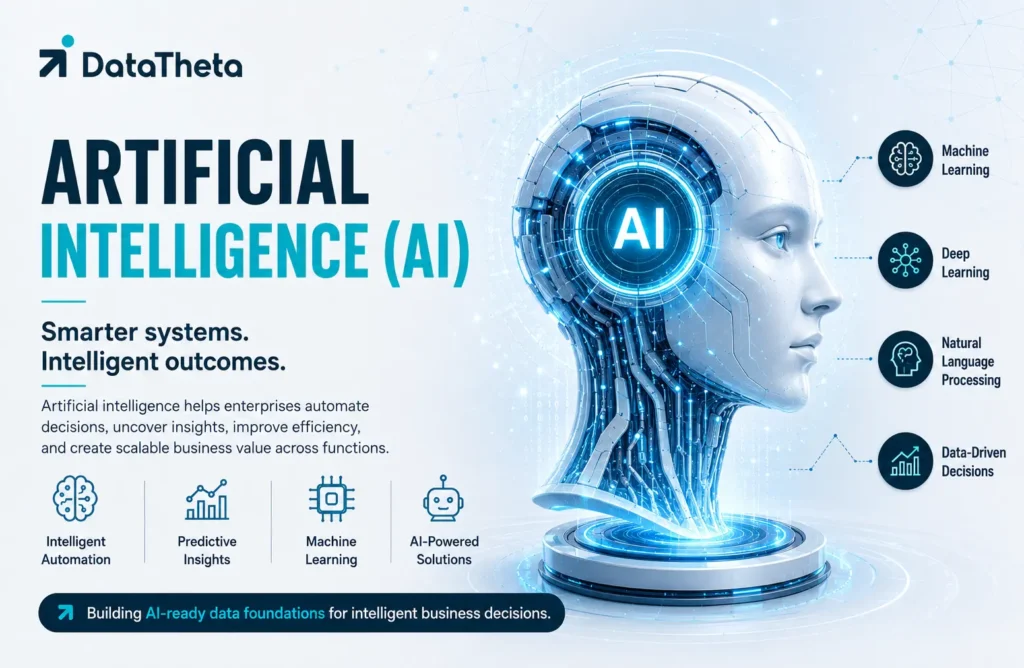
Artificial intelligence is the field of technology focused on creating systems that can perform tasks normally requiring human intelligence. These tasks include learning from data, recognising patterns, understanding language, solving problems, making predictions, and supporting decisions. AI is now used across healthcare, finance, manufacturing, retail, transportation, education, and customer service. It helps organisations automate repetitive work, improve accuracy, personalise experiences, and respond faster to changing conditions. However, successful AI adoption also requires reliable data, suitable infrastructure, governance, security, and human oversight. This article explains what artificial intelligence is, how it works, its major types, applications, advantages, challenges, implementation requirements, and future direction across modern businesses and society in coming years.
1. What Is Artificial Intelligence?
Artificial intelligence, commonly called AI, is a branch of computer science that develops systems capable of performing activities associated with human intelligence. These activities include learning, reasoning, recognising images, understanding language, interpreting information, planning actions, and making decisions.
AI systems use algorithms and data to identify patterns and produce outputs. Some systems follow predefined rules, while others improve their performance by learning from examples.
Most systems are designed for a specific purpose, such as detecting fraud, answering customer questions, forecasting demand, or identifying objects in an image.
1.1) Key Characteristics of Artificial Intelligence
- Learns patterns from historical and real-time data.
- Processes information faster than manual methods.
- Recognises images, speech, language, and behaviour.
- Makes predictions using statistical and computational models.
- Automates repetitive and decision-oriented business activities.
- Adapts outputs when new information becomes available.
- Supports humans with recommendations and analytical insights.
2. How Does Artificial Intelligence Work?
Artificial intelligence works by combining data, algorithms, computing infrastructure, and defined objectives. The system receives information, processes it through a model, and produces a prediction, recommendation, classification, response, or action.
2.1) Data Collection and Preparation
AI models require relevant data from sources such as applications, sensors, transactions, documents, images, customer interactions, and external platforms. The information must be cleaned, labelled, standardised, and checked for quality before training.
Incomplete or biased data can reduce accuracy and produce unfair outcomes.
2.2) Model Training
During training, an algorithm examines examples and learns relationships between inputs and expected outputs. A fraud model may learn patterns associated with suspicious transactions, while a language model learns relationships between words and sentences.
The model adjusts its internal parameters repeatedly until its performance reaches an acceptable level.
2.3) Testing and Evaluation
The trained model is tested using information it has not previously seen. Teams evaluate accuracy, reliability, fairness, explainability, processing speed, and business relevance.
Testing helps determine whether the model can perform consistently outside its training environment.
2.4) Deployment and Continuous Monitoring
After approval, the model is connected to applications, workflows, or decision systems. Its performance must be monitored because business conditions and data patterns can change.
Models may require retraining, updated controls, or human review to maintain dependable results.
3. Major Types of Artificial Intelligence
Artificial intelligence can be classified according to its capabilities and operating behaviour.
3.1) Narrow Artificial Intelligence
Narrow AI is designed to perform a specific task or limited set of activities. Examples include recommendation engines, virtual assistants, fraud detection systems, facial recognition, and demand forecasting.
Most AI systems currently used by businesses belong to this category.
3.2) General Artificial Intelligence
Artificial general intelligence refers to a theoretical system that could understand, learn, and perform a wide range of intellectual tasks at a human level.
General AI has not yet been achieved.
3.3) Reactive and Limited-Memory AI
Reactive systems respond to current inputs without retaining previous experiences. Limited-memory systems use historical information to improve decisions.
Many machine learning applications, autonomous driving functions, and recommendation systems use limited-memory capabilities.
3.4) Generative and Agentic AI
Generative AI creates new text, images, audio, video, code, and other content by learning patterns from existing information.
Agentic AI goes further by planning tasks, selecting tools, taking actions, and adjusting its approach to achieve a defined objective. These systems require strict permissions, monitoring, and human oversight.
4. Core Technologies Behind Artificial Intelligence
AI combines several technologies that allow machines to interpret information and perform intelligent activities.
4.1) Machine Learning
Machine learning enables systems to learn from data without receiving explicit instructions for every possible situation. It is used for prediction, classification, segmentation, recommendation, and anomaly detection.
4.2) Deep Learning
Deep learning uses multilayered neural networks to analyse complex information. It is commonly applied to image recognition, speech processing, language generation, autonomous systems, and medical imaging.
4.3) Natural Language Processing
Natural language processing allows systems to understand, analyse, and generate human language. It powers chatbots, translation tools, document analysis, sentiment detection, and voice assistants.
4.4) Computer Vision
Computer vision helps machines interpret images and video. It supports quality inspection, facial recognition, medical diagnosis, traffic monitoring, and visual search.
4.5) Robotics and Intelligent Automation
Robotics combines AI with machines that interact with physical environments. Intelligent automation combines AI with software workflows to manage repetitive tasks, documents, approvals, and decisions.
5. Major Applications of Artificial Intelligence
Artificial intelligence is used across industries to improve operations, customer experiences, forecasting, and decision-making.
5.1) Healthcare
AI supports medical imaging, patient-risk prediction, drug discovery, clinical documentation, remote monitoring, and treatment planning. It can help professionals analyse complex information more quickly while keeping final decisions under qualified human supervision.
5.2) Banking and Financial Services
Financial institutions use AI for fraud detection, credit assessment, anti-money-laundering monitoring, customer service, risk modelling, and personalised recommendations.
Real-time analysis allows suspicious transactions and unusual account activity to be identified more rapidly.
5.3) Manufacturing
Manufacturers apply AI to predictive maintenance, visual quality inspection, production planning, energy optimisation, and workplace safety. Sensor data can reveal early signs of equipment failure and reduce unplanned downtime.
5.4) Retail and E-Commerce
Retailers use AI for product recommendations, customer segmentation, demand forecasting, inventory planning, dynamic pricing, and conversational support.
5.5) Transportation and Logistics
AI supports route optimisation, delivery forecasting, fleet maintenance, traffic analysis, warehouse automation, and autonomous driving functions.
It helps logistics teams reduce delays, control fuel consumption, and respond to changing conditions.
5.6) Customer Service and Marketing
Virtual assistants can answer common questions, summarise conversations, classify requests, and route customers to suitable teams. Marketing systems use AI to analyse behaviour, personalise campaigns, and predict customer needs.
5.7) Cybersecurity
AI systems examine network activity, user behaviour, devices, and system events to identify anomalies and possible attacks. They help security teams prioritise alerts and respond to threats more efficiently.
6. Top 7 Advantages of Artificial Intelligence
Artificial intelligence can create significant value when it is aligned with clear objectives and supported by trusted data.
6.1) Increased Automation
AI automates repetitive, time-consuming, and rules-based activities. This reduces manual effort and allows employees to focus on judgement, creativity, customer relationships, and strategic work.
6.2) Faster Decision-Making
AI systems can process large datasets and produce recommendations quickly. Organisations can respond faster to operational issues, customer behaviour, financial risks, and market changes.
6.3) Improved Accuracy
Well-designed models can identify patterns that may be difficult to detect manually. AI can reduce errors in inspection, forecasting, classification, and data processing, although human review remains important in high-risk situations.
6.4) Personalised Experiences
AI analyses individual preferences, behaviour, and history to provide relevant products, content, services, and communications. Personalisation can improve engagement, satisfaction, and customer retention.
6.5) Better Forecasting
Predictive models use historical and current information to forecast demand, revenue, equipment failures, customer churn, and operational risks. Better forecasts support planning and resource allocation.
6.6) Continuous Availability
AI-powered systems can operate continuously and respond to routine requests outside normal working hours. This is useful for monitoring, customer support, fraud detection, and digital services.
6.7) Scalable Analysis
AI can analyse information volumes that would be difficult to process manually. Organisations can apply consistent analytical methods across large numbers of transactions, documents, images, or customer interactions.
7. Challenges and Responsible AI Practices
AI can create operational, ethical, legal, and security risks when it is implemented without suitable controls.
7.1) Common Artificial Intelligence Challenges
- Poor-quality or incomplete training information
- Bias affecting individuals or customer groups
- Limited explainability in complex models
- Privacy and confidential-data exposure
- Incorrect or fabricated generated outputs
- High infrastructure and implementation costs
- Model drift as business conditions change
- Security attacks targeting models and data
- Excessive dependence on automated recommendations
- Shortages of specialised technical skills
7.2) Responsible AI Best Practices
- Define clear business objectives before model development.
- Use representative, accurate, and legally permitted data.
- Test models for performance, bias, and reliability.
- Apply human review to important or high-risk decisions.
- Restrict access to confidential information and systems.
- Explain model limitations to users and decision-makers.
- Monitor outputs, data drift, and unusual behaviour.
- Maintain documentation, accountability, and audit records.
- Establish escalation procedures for incorrect outcomes.
- Review models regularly against legal and ethical requirements.
8. Artificial Intelligence, Machine Learning, and Deep Learning
These terms are connected but do not describe exactly the same field.
8.1) Relationship Between the Technologies
Artificial intelligence is the broad discipline of creating systems that perform intelligent tasks. Machine learning is a branch of AI that allows systems to learn patterns from data. Deep learning is a specialised form of machine learning that uses multilayered neural networks.
A recommendation system may use machine learning, while an image-recognition system may use deep learning. Both belong to the wider field of artificial intelligence.
8.2) Main Differences
- AI includes rule-based systems, learning models, robotics, and reasoning.
- Machine learning improves performance by learning from examples.
- Deep learning handles complex patterns using neural networks.
- AI represents the broad objective of machine intelligence.
- Machine learning is one approach used to achieve that objective.
- Deep learning is especially useful for language, image, and audio tasks.
9. Future of Artificial Intelligence
The future of AI will involve more capable systems, deeper integration with business processes, and greater attention to governance.
9.1) Growth of Generative AI
Generative systems will continue supporting content creation, software development, document analysis, knowledge access, product design, and customer communication. Organisations will increasingly connect these models to trusted enterprise information.
9.2) Expansion of Agentic AI
AI agents will plan and complete multi-step tasks using approved tools and systems. Their adoption will depend on controlled access, audit trails, human approval points, and reliable monitoring.
9.3) Human and AI Collaboration
AI is likely to augment many roles rather than simply replace complete occupations. Employees will use intelligent assistants to research, analyse information, draft content, identify risks, and make better-informed decisions.
9.4) Stronger Regulation and Governance
Governments and organisations will introduce clearer requirements for transparency, privacy, security, fairness, and accountability. AI governance will become a standard part of enterprise risk management.
9.5) More Efficient and Specialised Models
Smaller models designed for specific industries or tasks may provide lower costs, faster processing, improved privacy, and better control. AI will also move closer to devices and operational environments through edge computing.
Conclusion
Artificial intelligence enables machines to learn from data, recognise patterns, generate content, make predictions, and support decisions. Its applications now extend across healthcare, finance, manufacturing, retail, logistics, customer service, and cybersecurity. AI can increase automation, improve accuracy, personalise experiences, strengthen forecasting, and analyse information at scale. However, these advantages depend on reliable data, appropriate infrastructure, responsible governance, security, and human oversight. As generative and agentic systems become more capable, organisations must balance innovation with transparency and accountability. Businesses that select valuable use cases, monitor performance, and maintain clear controls will be better positioned to use AI safely and achieve sustainable results.