


Introduction
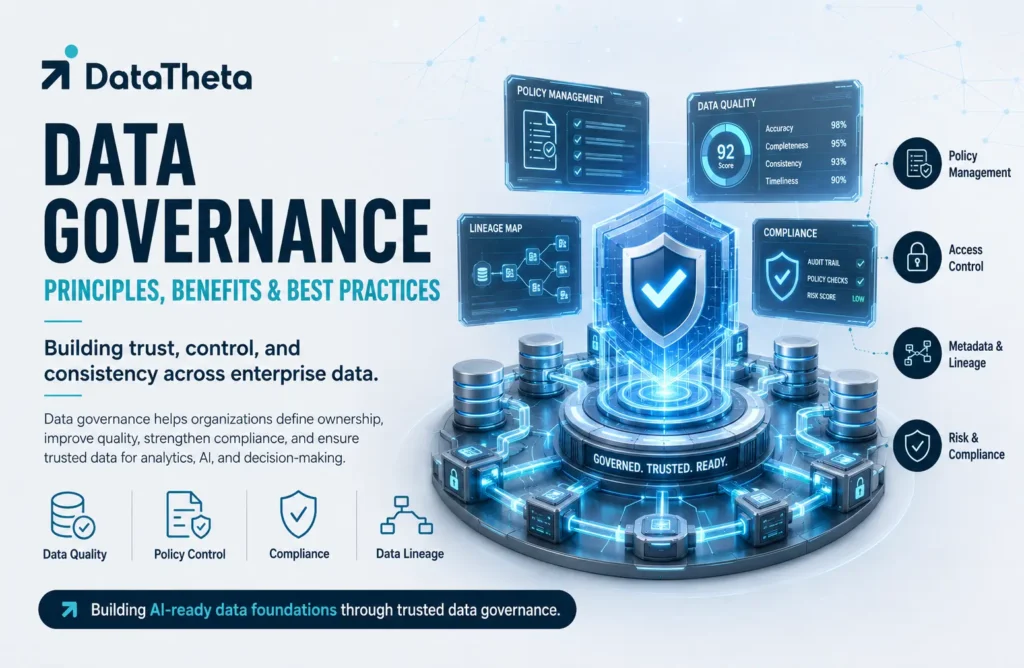
Data governance is the framework of policies, roles, standards, processes, and controls used to manage organisational data responsibly. It helps ensure that information remains accurate, consistent, secure, accessible, traceable, and compliant throughout its lifecycle. Organisations use data governance to establish ownership, improve quality, standardise definitions, protect sensitive information, and support trustworthy reporting, analytics, and artificial intelligence. Effective governance connects business teams, technology teams, security leaders, and data owners around shared responsibilities. Its success depends on executive support, clear accountability, practical policies, suitable technology, and continuous monitoring. This article explains data governance, its principles, components, benefits, implementation challenges, best practices, and future importance across modern data-driven organisations worldwide today.
What Is Data Governance? Its Principles, Benefits, and Best Practices
1. What Is Data Governance?
Data governance is the system through which an organisation defines how data should be owned, managed, protected, used, and monitored. It establishes policies, responsibilities, standards, and decision-making structures for information across departments, applications, and business processes.
Data governance helps organisations maintain consistent definitions, improve data quality, control access, document lineage, and comply with legal or regulatory requirements. It also ensures that data is used appropriately and remains trustworthy for reporting, analytics, artificial intelligence, and operational decisions.
Governance is not limited to technology. It requires collaboration between business users, data owners, data stewards, security teams, compliance specialists, and technology professionals.
1.1) Key Characteristics of Data Governance
- Establishes ownership and accountability for important data.
- Defines policies, standards, and approved data practices.
- Improves accuracy, consistency, completeness, and timeliness.
- Protects sensitive information through access controls.
- Maintains metadata, definitions, and data lineage.
- Supports regulatory, privacy, and security requirements.
- Creates trusted data for reporting, analytics, and AI.
2. Why Is Data Governance Important?
Organisations rely on data for financial reporting, customer service, planning, risk management, artificial intelligence, and everyday operations. However, information may be duplicated, inconsistent, outdated, poorly documented, or accessed by unauthorised users.
Without governance, departments may use different definitions for the same metric, such as revenue, customer, product, or order. These inconsistencies reduce trust and make decision-making more difficult.
Data governance creates a structured approach for resolving such issues. It ensures that important information has defined owners, quality expectations, security controls, and approved usage rules.
2.1) Business Problems Addressed by Data Governance
- Conflicting definitions of important business terms
- Incomplete, duplicated, or inaccurate information
- Unclear ownership and responsibility for data
- Unauthorised access to sensitive records
- Difficulty tracing information to its source
- Inconsistent reporting across departments
- Regulatory and privacy compliance risks
- Poor-quality data affecting analytics and AI
- Uncontrolled creation of duplicate datasets
- Limited understanding of how data is used
3. Core Principles of Data Governance
Effective governance is built on principles that guide how information should be managed and used.
3.1) Accountability
Every important data domain should have an assigned owner responsible for quality, access, definitions, and appropriate use.
Clear accountability prevents important issues from remaining unresolved.
3.2) Transparency
Users should understand where data originated, how it was transformed, who owns it, and how it may be used.
Transparency improves trust, auditability, and decision-making.
3.3) Standardisation
Shared definitions, formats, naming conventions, and calculation methods reduce inconsistency across teams and systems.
Standardisation helps organisations create a common understanding of business information.
3.4) Data Quality
Governance should establish measurable expectations for accuracy, completeness, consistency, uniqueness, validity, and timeliness.
Quality rules should be monitored and corrected continuously.
3.5) Security and Privacy
Sensitive information must be protected through access controls, encryption, masking, classification, retention, and monitoring.
Privacy requirements should guide how personal information is collected, stored, shared, and deleted.
3.6) Accessibility and Usability
Authorised users should be able to find and understand relevant data without unnecessary delays.
Governance should balance protection with practical access.
3.7) Compliance and Ethical Use
Data must be managed according to laws, regulations, contractual obligations, internal policies, and ethical principles.
Responsible use is especially important for automated decisions and artificial intelligence.
4. Core Components of a Data Governance Framework
A complete governance programme combines people, processes, policies, technology, and measurement.
4.1) Data Policies and Standards
Policies define how data should be collected, classified, accessed, shared, retained, and deleted. Standards provide detailed rules for naming, formatting, quality, documentation, and integration.
4.2) Data Ownership and Stewardship
Data owners are accountable for specific business domains, while data stewards manage definitions, quality issues, metadata, and everyday governance activities.
4.3) Data Quality Management
Data quality management identifies, measures, and resolves problems affecting accuracy, completeness, consistency, and timeliness.
Common quality controls include:
- Duplicate detection
- Mandatory field validation
- Format verification
- Relationship checks
- Reconciliation rules
- Freshness monitoring
- Exception reporting
4.4) Metadata Management
Metadata describes the meaning, structure, source, owner, classification, and usage of information.
A business glossary and data catalogue help users discover and understand available datasets.
4.5) Data Lineage
Data lineage shows how information moves from source systems through transformations into reports, models, and applications.
It supports troubleshooting, impact analysis, auditing, and compliance.
4.6) Security and Access Management
Security controls determine who can view, change, share, or delete information. Access should be based on business roles and the principle of least privilege.
4.7) Governance Monitoring and Measurement
Governance programmes should track data quality, issue resolution, ownership, policy compliance, usage, and business outcomes.
Measurement helps demonstrate value and identify areas requiring improvement.
5. Major Applications of Data Governance
Data governance supports reliable information management across business and technology initiatives.
5.1) Regulatory Compliance
Governance helps organisations document data sources, access, retention, processing, and usage. This supports privacy, financial reporting, industry regulations, and audit requirements.
5.2) Business Intelligence and Reporting
Standard definitions and quality rules improve consistency across dashboards, reports, and performance measures.
Decision-makers can use information with greater confidence.
5.3) Artificial Intelligence and Machine Learning
AI models require accurate, relevant, authorised, and traceable information. Governance helps control training data, access, quality, bias, lineage, and responsible use.
5.4) Customer Data Management
Governance helps organisations create consistent customer definitions, manage consent, reduce duplicate records, and control access to personal information.
5.5) Data Migration and Cloud Modernisation
During migration, governance helps identify owners, classify information, define quality expectations, and determine what data should be moved, archived, or removed.
5.6) Master Data Management
Master data governance creates consistent records for customers, products, suppliers, employees, and locations across different systems.
5.7) Data Sharing and Collaboration
Governance defines how data may be shared between departments, partners, applications, and external organisations.
Clear controls reduce misuse and improve collaboration.
6. Top 7 Benefits of Data Governance
A practical governance programme improves trust, control, and business value across the data environment.
6.1) Improved Data Quality
Governance defines quality standards, ownership, and correction processes. This reduces inaccurate, incomplete, and duplicated information.
6.2) Consistent Business Definitions
Shared glossaries and calculation rules ensure that departments interpret important terms and metrics consistently.
6.3) Stronger Regulatory Compliance
Policies, lineage, access records, and retention controls help organisations demonstrate compliance and respond to audits efficiently.
6.4) Better Data Security
Governance strengthens classification, access control, monitoring, encryption, and handling of sensitive information.
6.5) Greater Trust in Reporting and Analytics
Users are more likely to trust dashboards, reports, and models when data is governed, documented, and quality-checked.
6.6) Improved AI Readiness
Governed data provides reliable inputs for artificial intelligence and machine learning while reducing privacy, bias, and accountability risks.
6.7) Faster and More Confident Decisions
Clear ownership, accessible definitions, and trusted data reduce delays and help leaders make decisions with greater confidence.
7. Common Data Governance Challenges
Governance initiatives may fail when they become overly complex, technology-focused, or disconnected from business priorities.
7.1) Lack of Executive Sponsorship
Without leadership support, governance teams may lack authority, funding, and participation from business departments.
7.2) Unclear Ownership
When responsibilities are not assigned, quality issues and access decisions may remain unresolved.
7.3) Organisational Resistance
Employees may view governance as additional bureaucracy. Adoption improves when policies are practical and connected to real business problems.
7.4) Fragmented Data Environments
Information may be spread across legacy applications, cloud platforms, spreadsheets, and external systems, making governance more difficult.
7.5) Manual Governance Processes
Spreadsheet-based tracking and manual approvals can become slow, inconsistent, and difficult to scale.
7.6) Limited Governance Skills
Governance requires expertise in business processes, data management, technology, privacy, security, and communication.
7.7) Difficulty Measuring Value
Benefits such as improved trust and reduced risk may be difficult to quantify without clear performance measures.
8. Data Governance Best Practices
Successful governance should be practical, measurable, and closely connected to business priorities.
8.1) Start with High-Value Data
Begin with information that supports important reports, regulatory requirements, customer processes, or AI initiatives.
A focused approach produces measurable results more quickly.
8.2) Assign Clear Roles
Define responsibilities for data owners, stewards, custodians, users, governance councils, and technology teams.
8.3) Create a Business Glossary
Document important business terms, calculations, owners, and approved definitions.
The glossary should be accessible and regularly maintained.
8.4) Automate Quality Monitoring
Use automated rules to detect missing values, duplicates, invalid formats, unusual changes, and delayed data.
8.5) Integrate Governance into Workflows
Governance activities should be part of system development, reporting, data integration, AI deployment, and operational processes.
8.6) Apply Risk-Based Controls
Sensitive or high-impact information requires stronger controls than low-risk datasets.
Governance effort should reflect business value and potential harm.
8.7) Maintain Metadata and Lineage
Document data sources, transformations, ownership, classifications, dependencies, and approved usage.
8.8) Measure Governance Performance
Track indicators such as quality scores, unresolved issues, ownership coverage, policy compliance, user adoption, and time required to resolve problems.
8.9) Educate Data Users
Employees should understand their responsibilities for data quality, access, privacy, security, and responsible use.
9. Data Governance and Data Management
Data governance and data management are closely related but serve different purposes.
9.1) Role of Data Governance
Data governance defines authority, policies, standards, ownership, and decision-making responsibilities.
It determines what should be done and who is accountable.
9.2) Role of Data Management
Data management performs the technical and operational activities required to collect, store, integrate, secure, and maintain information.
It focuses on how governance requirements are implemented.
9.3) Main Differences
- Governance defines policies and accountability.
- Data management implements technical processes.
- Governance establishes quality expectations.
- Management operates pipelines, databases, and platforms.
- Governance assigns ownership and usage rights.
- Management maintains availability, security, and performance.
Both capabilities must work together to create dependable information.
10. Future of Data Governance
Data governance is evolving as organisations adopt cloud platforms, artificial intelligence, real-time analytics, and decentralised data architectures.
10.1) Automated Data Governance
Automation will help classify data, identify sensitive information, detect quality issues, maintain metadata, and enforce policies.
10.2) AI Governance Integration
Data governance will increasingly connect with AI governance to manage training information, model inputs, outputs, bias, lineage, and accountability.
10.3) Active Metadata Management
Modern platforms will use metadata to automate discovery, quality monitoring, impact analysis, and access recommendations.
10.4) Federated Governance
Federated models will distribute ownership across business domains while maintaining shared enterprise policies and standards.
10.5) Privacy-Enhancing Technologies
Organisations will adopt masking, tokenisation, synthetic data, confidential computing, and other methods to protect sensitive information while supporting analysis.
Conclusion
Data governance establishes the policies, roles, standards, and controls required to manage information responsibly. It improves quality, standardises business definitions, protects sensitive records, maintains lineage, and supports regulatory compliance. Organisations apply governance to reporting, artificial intelligence, customer data, cloud migration, master data, and information sharing. Its benefits include greater trust, stronger security, improved AI readiness, consistent metrics, and faster decision-making. However, successful governance requires executive sponsorship, clear ownership, practical policies, automation, education, and measurable outcomes. Businesses that embed governance into everyday processes can reduce risk, improve data value, and create a dependable foundation for analytics, automation, and long-term digital growth.