

Introduction
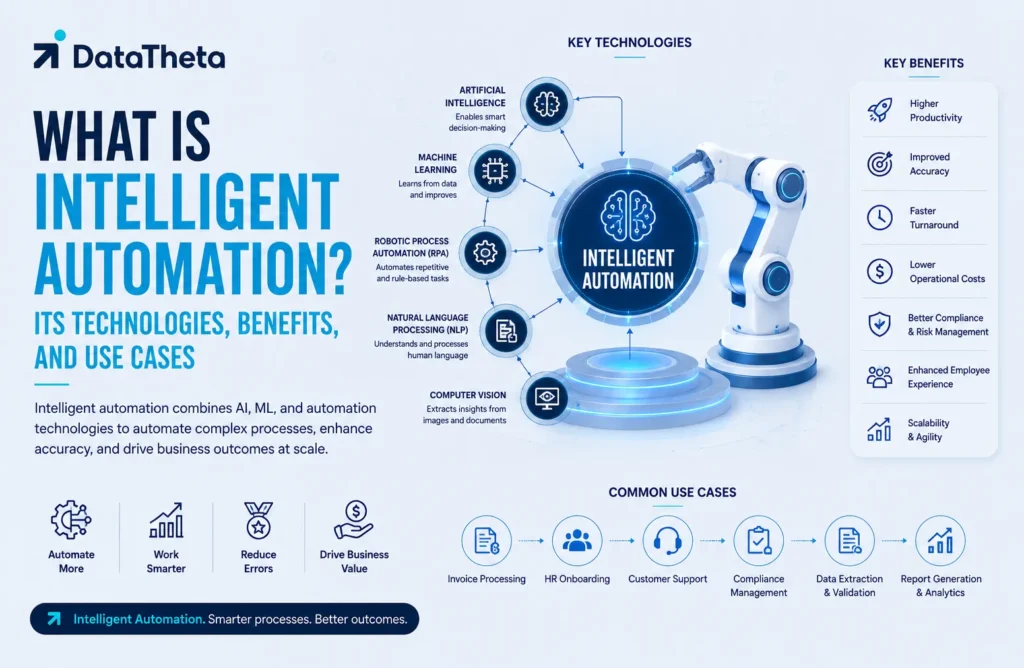
Intelligent automation combines artificial intelligence, robotic process automation, analytics, and workflow technologies to automate complex business activities. Unlike basic automation, which follows fixed rules, intelligent automation can interpret information, recognise patterns, support decisions, and adapt to changing conditions. Organisations use it to reduce manual work, improve accuracy, accelerate operations, strengthen customer service, and scale repetitive processes. Its effectiveness depends on reliable data, well-designed workflows, suitable technologies, governance, security, and human oversight. This article explains what intelligent automation is, how it works, its core technologies, major applications, business benefits, implementation challenges, best practices, and future importance across modern organisations, industries, increasingly digital operating environments, and enterprise transformation programmes worldwide today globally.
1. What Is Intelligent Automation?
Intelligent automation is the use of artificial intelligence, robotic process automation, business process management, analytics, and integration technologies to automate business activities that involve both repetitive tasks and judgement.
Traditional automation usually follows predefined instructions. It performs the same action whenever specific conditions occur. Intelligent automation extends this capability by interpreting documents, understanding language, recognising patterns, predicting outcomes, and recommending or executing actions.
For example, a basic automation tool may transfer information from one application to another. An intelligent automation system may first read an invoice, extract relevant fields, validate the supplier, identify unusual values, route exceptions, and update the financial system.
1.1) Key Characteristics of Intelligent Automation
- Combines rule-based automation with artificial intelligence.
- Processes structured and unstructured information.
- Supports judgement-based and repetitive activities.
- Connects applications, data, people, and workflows.
- Learns from patterns and operational outcomes.
- Routes unusual cases to human reviewers.
- Operates continuously across high-volume processes.
- Improves through monitoring, feedback, and model updates.
2. Why Is Intelligent Automation Important?
Many organisations still depend on employees to enter data, review documents, respond to common requests, reconcile records, and transfer information between systems. These activities can be slow, inconsistent, and difficult to scale.
Basic automation can address predictable tasks, but many business processes include emails, documents, images, exceptions, and changing conditions. Intelligent automation helps manage this complexity by combining automated workflows with analytical and cognitive capabilities.
It allows employees to focus on customer relationships, problem-solving, innovation, and other activities requiring human expertise.
2.1) Business Problems Addressed by Intelligent Automation
- Employees repeatedly enter the same information.
- Manual processes create errors and delays.
- Unstructured documents require extensive review.
- Customers wait too long for routine responses.
- Legacy systems cannot exchange information easily.
- High transaction volumes increase operating costs.
- Business rules are applied inconsistently.
- Exceptions are difficult to identify and prioritise.
- Operational processes lack visibility and traceability.
- Organisations struggle to scale services efficiently.
3. How Does Intelligent Automation Work?
Intelligent automation follows a sequence of capturing information, understanding context, applying rules or models, completing actions, and learning from results.
3.1) Capture Information
The system collects information from emails, forms, databases, documents, applications, websites, sensors, and external platforms.
Optical character recognition, document processing, and speech technologies may convert unstructured content into usable data.
3.2) Interpret and Analyse Data
Artificial intelligence models classify information, extract important details, recognise patterns, and estimate likely outcomes.
For example, a system may identify an invoice number, determine the type of customer request, or assess whether a transaction appears unusual.
3.3) Apply Rules and Decisions
Business rules, predictive models, and decision logic determine the appropriate next action.
The system may approve a standard request, reject invalid information, request additional details, or escalate a complex case.
3.4) Execute the Workflow
Robotic process automation, APIs, and workflow tools complete tasks across applications. These tasks may include updating records, generating documents, sending notifications, or creating service tickets.
3.5) Monitor and Improve
Performance, exceptions, errors, processing times, and business outcomes are monitored continuously.
Feedback helps organisations improve rules, models, workflows, and automation coverage.
4. Core Technologies Used in Intelligent Automation
Intelligent automation combines several technologies rather than relying on a single tool.
4.1) Robotic Process Automation
Robotic process automation uses software bots to perform repetitive, rule-based tasks across digital applications.
Bots can copy data, complete forms, download files, generate reports, and update systems without changing the underlying applications.
4.2) Artificial Intelligence and Machine Learning
Artificial intelligence and machine learning help systems identify patterns, classify records, predict outcomes, and support decisions.
These capabilities are useful when processes involve variability, uncertainty, or large datasets.
4.3) Intelligent Document Processing
Intelligent document processing extracts, classifies, and validates information from invoices, contracts, forms, claims, and identification documents.
It combines optical character recognition, machine learning, and natural language processing.
4.4) Natural Language Processing
Natural language processing enables systems to understand and generate human language.
It supports email classification, chatbots, sentiment analysis, document summarisation, search, and customer-service automation.
4.5) Business Process Management
Business process management tools model, coordinate, and monitor end-to-end workflows involving employees, systems, bots, and approvals.
They provide visibility into process stages, delays, exceptions, and responsibilities.
4.6) Process Mining
Process mining analyses system event logs to show how activities actually move through business processes.
It identifies bottlenecks, repeated work, process variations, and automation opportunities.
4.7) Integration Technologies
APIs, middleware, connectors, and integration platforms allow applications and automation tools to exchange information securely.
Integration reduces dependence on screen-based automation and improves reliability.
5. Major Use Cases of Intelligent Automation
Intelligent automation supports finance, customer service, human resources, supply chains, healthcare, banking, and other business functions.
5.1) Invoice and Accounts Payable Processing
Systems can capture invoices, extract fields, validate suppliers, match purchase orders, identify duplicates, and route exceptions for approval.
This reduces manual entry and accelerates payment processing.
5.2) Customer Service Automation
Chatbots and workflow tools can answer common questions, classify requests, retrieve customer information, and create support tickets.
Complex or sensitive cases can be transferred to employees with relevant context.
5.3) Insurance Claims Processing
Intelligent automation can collect claim information, examine documents, check policy coverage, detect inconsistencies, and route cases according to risk.
Human specialists remain involved in complex or disputed claims.
5.4) Banking and Financial Operations
Banks use intelligent automation for customer onboarding, account servicing, transaction monitoring, compliance checks, reconciliation, and loan processing.
Automated controls improve speed while maintaining auditability.
5.5) Human Resources Operations
HR teams automate candidate screening, employee onboarding, payroll checks, leave requests, document generation, and employee enquiries.
This improves service consistency and reduces administrative work.
5.6) Supply Chain and Procurement
Intelligent automation supports purchase-order processing, supplier onboarding, inventory monitoring, shipment tracking, demand alerts, and invoice reconciliation.
5.7) Healthcare Administration
Healthcare organisations automate appointment scheduling, claims administration, patient-document processing, billing, and routine communication.
Clinical decisions should continue to involve qualified professionals and appropriate oversight.
6. Top 7 Benefits of Intelligent Automation
Intelligent automation can improve productivity, quality, scalability, and customer experience.
6.1) Greater Operational Efficiency
Automated systems complete repetitive tasks more quickly and consistently than manual processes.
Employees can focus on activities requiring judgement, creativity, and relationship management.
6.2) Reduced Processing Costs
Automation lowers the effort required to handle transactions, documents, service requests, and administrative workflows.
Cost savings depend on selecting suitable processes and maintaining the technology effectively.
6.3) Improved Accuracy
Automated validation and standardised rules reduce data-entry errors, missed steps, duplicate processing, and inconsistent decisions.
6.4) Faster Customer Service
Routine requests can be processed continuously without waiting for manual availability.
Customers receive quicker responses, while employees concentrate on more complex cases.
6.5) Greater Scalability
Organisations can manage higher transaction volumes without increasing staffing at the same rate.
Automation can also support seasonal demand and business expansion.
6.6) Stronger Compliance and Traceability
Automated workflows create records of actions, approvals, exceptions, and changes.
This supports audits, regulatory reporting, and internal controls.
6.7) Better Employee Experience
Removing repetitive and low-value work allows employees to focus on meaningful responsibilities and develop more advanced skills.
7. Common Intelligent Automation Challenges
Automation programmes may fail when organisations focus on technology without redesigning processes or defining ownership.
7.1) Poorly Designed Processes
Automating an inefficient or unnecessary process may increase its speed without improving its value.
Processes should be simplified before automation.
7.2) Fragmented Legacy Systems
Older applications may lack APIs, consistent interfaces, or reliable data.
Screen-based automation can connect these systems but may become fragile when interfaces change.
7.3) Poor Data Quality
Inaccurate, incomplete, or inconsistent data reduces the reliability of automated decisions and workflows.
7.4) Complex Exceptions
Some processes contain many unusual cases that require human judgement.
Automation should identify and route these exceptions rather than forcing unsuitable decisions.
7.5) Employee Resistance
Employees may fear job loss or distrust automated recommendations.
Clear communication, training, and workforce planning are essential for adoption.
7.6) Security and Privacy Risks
Automation tools may access sensitive customer, employee, financial, or health information.
Credentials, permissions, data movement, and audit logs must be controlled carefully.
7.7) Difficulty Measuring Value
Automating many small tasks does not always create significant business value.
Organisations should measure cost, speed, quality, customer outcomes, and employee productivity.
8. Intelligent Automation Best Practices
Successful intelligent automation combines process improvement, appropriate technology, governance, and continuous monitoring.
8.1) Begin with Clear Business Outcomes
Define whether the initiative should reduce costs, improve service, shorten processing time, strengthen compliance, or increase capacity.
8.2) Select Suitable Processes
Good candidates usually have:
- High transaction volumes
- Repetitive activities
- Clear rules
- Stable inputs
- Measurable outcomes
- Significant manual effort
- Manageable exception rates
8.3) Simplify Before Automating
Remove unnecessary approvals, repeated data entry, and outdated process steps before introducing automation.
8.4) Combine APIs and Bots Appropriately
Use APIs and direct integration where possible. Use robotic process automation when applications cannot be connected through more stable methods.
8.5) Maintain Human Oversight
Require human review for sensitive, uncertain, unusual, or high-impact cases.
Employees should be able to understand, challenge, and override automated recommendations where appropriate.
8.6) Apply Security by Design
Use least-privilege access, encryption, secure credential storage, activity logging, and regular access reviews.
8.7) Establish Automation Governance
Define ownership, development standards, testing requirements, approval procedures, monitoring responsibilities, and retirement criteria.
8.8) Monitor Performance Continuously
Track processing time, error rates, exception volumes, availability, customer outcomes, costs, and employee adoption.
8.9) Scale Through Reusable Components
Create standard connectors, document models, workflow templates, controls, and automation libraries that can support multiple processes.
9. Intelligent Automation and Robotic Process Automation
Intelligent automation and robotic process automation are related but not identical.
9.1) Role of Robotic Process Automation
Robotic process automation follows predefined instructions to complete repetitive digital tasks.
It is most effective when inputs, interfaces, and rules remain stable.
9.2) Role of Intelligent Automation
Intelligent automation combines RPA with AI, analytics, document processing, process management, and decision technologies.
It can manage more complex information and workflow variations.
9.3) Relationship Between the Approaches
RPA often acts as the execution layer within a broader intelligent automation system.
Artificial intelligence interprets information, decision logic selects an action, and software bots or APIs complete the required task.
10. Future of Intelligent Automation
Intelligent automation is becoming more conversational, adaptive, autonomous, and integrated across business operations.
10.1) Generative AI Integration
Generative AI can summarise documents, draft responses, extract information, explain cases, and support employee decision-making.
10.2) Agentic Automation
AI agents will increasingly coordinate multiple tasks, applications, tools, and decisions to complete broader business objectives.
Strong controls will be required to limit their access and actions.
10.3) Hyperautomation
Hyperautomation combines process discovery, AI, RPA, integration, analytics, and workflow management to automate processes systematically across an organisation.
10.4) Greater Process Intelligence
Process and task mining will help organisations identify automation opportunities and measure how workflows perform in practice.
10.5) Human-Automation Collaboration
Future operating models will combine automated execution with human judgement, creativity, empathy, and accountability.
Conclusion
Intelligent automation combines artificial intelligence, robotic process automation, document processing, analytics, integration, and workflow management to automate complex business activities. Organisations use it for invoice processing, customer service, insurance claims, banking, human resources, supply chains, and healthcare administration. Its benefits include greater efficiency, lower costs, improved accuracy, faster service, scalability, stronger compliance, and better employee experiences. However, successful implementation requires simplified processes, reliable data, secure integration, human oversight, governance, and continuous monitoring. Businesses should focus on measurable outcomes rather than automating every available task. When applied responsibly, intelligent automation can improve operations while allowing employees to concentrate on higher-value and more complex work.