

Introduction
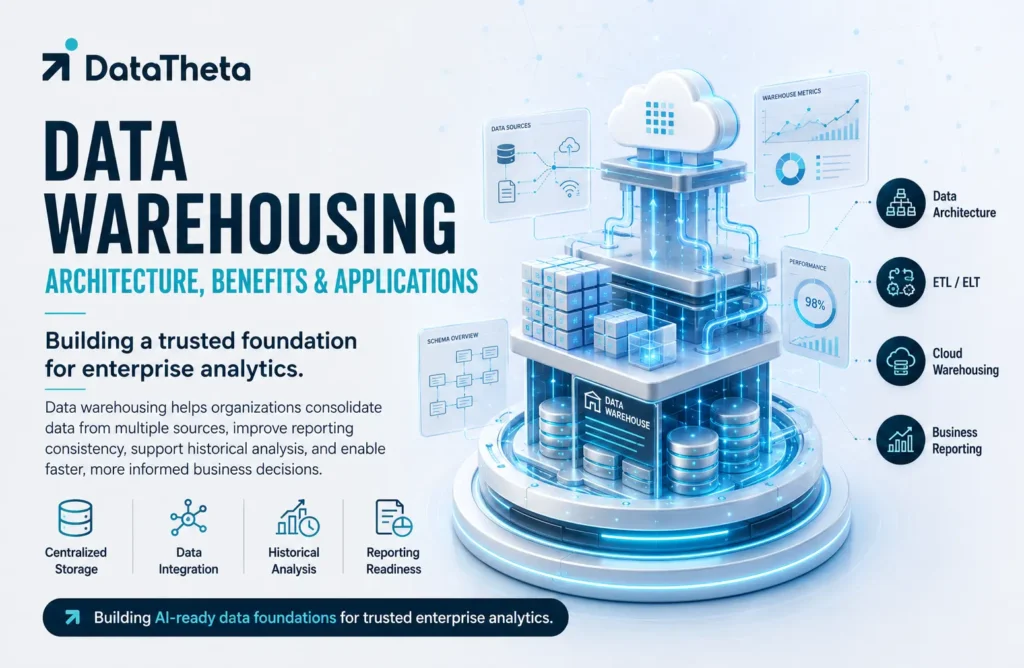
Data warehousing is the process of collecting, integrating, storing, and organising business data in a central environment designed for reporting and analysis. It brings information from finance, sales, marketing, operations, customer service, and other systems into a consistent structure. Organisations use data warehouses to create trusted reports, monitor performance, analyse historical trends, and support strategic decisions. Modern platforms also enable self-service analytics, artificial intelligence, and scalable cloud reporting. Their success depends on reliable pipelines, suitable architecture, data quality, governance, security, and clear business definitions. This article explains data warehousing, its architecture, components, types, applications, benefits, challenges, best practices, and future importance for modern organisations across increasingly complex digital business environments.
What Is Data Warehousing? Its Architecture, Benefits, and Applications
1. What Is Data Warehousing?
Data warehousing is the practice of collecting data from multiple operational systems and storing it in a central repository designed for analysis, reporting, and decision-making. A data warehouse organises information into consistent structures so users can examine performance across departments, products, customers, locations, and periods.
Operational systems process daily activities such as orders, payments, and inventory updates. A warehouse separates analytical workloads from these systems and preserves historical information for comparisons and trend analysis.
1.1) Key Characteristics of a Data Warehouse
- Integrates data from multiple internal and external systems.
- Stores historical information for trend and comparison analysis.
- Organises data for fast reporting and analytical queries.
- Uses standard definitions for important business measures.
- Separates analytical workloads from operational applications.
- Supports dashboards, business intelligence, and advanced analytics.
- Protects information through governance and security controls.
2. How Does Data Warehousing Work?
Data warehousing follows a structured process that moves information from source systems into an analytical environment. The workflow commonly includes extraction, preparation, transformation, loading, storage, modelling, and delivery.
2.1) Data Collection
Information is collected from systems such as enterprise resource planning platforms, customer relationship management applications, financial software, e-commerce platforms, inventory systems, websites, spreadsheets, APIs, and external providers.
2.2) Data Ingestion
Data ingestion transfers information from source systems into a staging area or directly into the warehouse.
Batch ingestion moves data at scheduled intervals, while streaming or near-real-time ingestion supports more frequent updates.
2.3) Data Transformation
Raw information is cleaned and standardised before it becomes available for analysis. Transformation may include:
- Removing duplicate records
- Correcting invalid or missing values
- Standardising dates, currencies, and categories
- Matching customer, product, or supplier records
- Applying business rules and calculations
- Combining information from several systems
- Creating historical versions of important records
2.4) Data Storage and Modelling
Prepared information is stored in structured tables and organised according to analytical requirements.
Common models include fact tables containing measurable business events and dimension tables describing customers, products, dates, locations, or departments.
2.5) Reporting and Analysis
Business intelligence tools, dashboards, applications, and analysts query the warehouse. Users can monitor performance, compare results, investigate trends, and create recurring reports from governed information.
3. Data Warehouse Architecture
Data warehouse architecture defines how information moves from source systems to storage, processing, and reporting layers. The appropriate design depends on scale, performance, security, integration, and business requirements.
3.1) Single-Tier Architecture
A single-tier architecture keeps analytical information close to its source. It is simple but offers limited separation between operational processing and analysis, making it unsuitable for many complex enterprises.
3.2) Two-Tier Architecture
A two-tier architecture connects business intelligence tools directly to the warehouse.
It can support smaller environments but becomes harder to manage as users, data volumes, and reporting requirements increase.
3.3) Three-Tier Architecture
Three-tier architecture is a widely used enterprise design. Its layers generally include:
- A bottom tier containing source systems and warehouse storage
- A middle tier containing processing, modelling, and analytical services
- A top tier containing dashboards, reports, and user tools
This structure improves scalability, governance, performance, and control.
3.4) Cloud Data Warehouse Architecture
Cloud architecture uses managed storage, computing, integration, and analytics services. It supports elastic scaling, automated maintenance, disaster recovery, and integration with artificial intelligence services.
3.5) Modern Lakehouse Architecture
A lakehouse combines the flexible storage capabilities of a data lake with the management and analytical features of a data warehouse.
It supports structured, semi-structured, and unstructured information within a unified environment.
4. Core Components of a Data Warehouse
A complete data warehousing environment includes several connected layers and services.
4.1) Source Systems
Source systems generate the information used for analysis. Their structure, quality, availability, and update frequency influence warehouse design.
4.2) Staging Area
The staging area temporarily holds extracted information before transformation and loading, allowing teams to validate records and handle errors.
4.3) ETL and ELT Pipelines
ETL extracts, transforms, and then loads information into the warehouse.
ELT loads raw data first and performs transformations within the destination platform. Modern cloud warehouses commonly use ELT because they provide scalable computing resources.
4.4) Central Storage Layer
The storage layer holds detailed and summarised historical information in structures optimised for analytical workloads.
4.5) Semantic and Reporting Layers
A semantic layer translates technical structures into understandable business terms and defines common measures for consistent reporting.
4.6) Governance and Security
Governance defines ownership, quality rules, retention, lineage, and approved usage.
Security controls manage authentication, permissions, encryption, masking, auditing, and regulatory requirements.
5. Major Types of Data Warehouses
Different warehouse types support different organisational scopes and analytical requirements.
5.1) Enterprise Data Warehouse
An enterprise data warehouse integrates information across the organisation for cross-functional reporting and strategic analysis.
5.2) Data Mart
A data mart contains information for a specific function or subject, such as finance, sales, marketing, or human resources.
It should follow enterprise standards to avoid creating new data silos.
5.3) Operational Data Store
An operational data store integrates current information from multiple systems for short-term reporting and operational monitoring.
5.4) Cloud Data Warehouse
A cloud data warehouse offers elastic scalability, reduced infrastructure administration, and integration with cloud analytics and artificial intelligence services.
6. Major Applications of Data Warehousing
Data warehousing supports consistent reporting and analysis across business functions.
6.1) Financial Reporting and Planning
Finance teams use data warehouses for budgeting, forecasting, profitability analysis, cash-flow monitoring, reconciliation, management reporting, and regulatory submissions.
6.2) Sales and Customer Analytics
Sales teams analyse revenue, conversion rates, pipelines, customer activity, product demand, and regional performance.
Integrated customer information also supports retention analysis and personalisation.
6.3) Supply Chain and Inventory Management
Warehouses combine procurement, inventory, supplier, logistics, and order information to improve demand planning and delivery performance.
6.4) Marketing Performance
Marketing teams analyse campaign reach, engagement, acquisition costs, conversions, and return on investment.
A data warehouse provides consistent information across marketing channels.
6.5) Healthcare and Insurance Analytics
Healthcare and insurance organisations analyse claims, service utilisation, costs, risk, and operational performance while applying strict privacy controls.
6.6) Regulatory and Compliance Reporting
Data warehouses preserve historical records, transformation logic, and lineage.
These capabilities help organisations produce repeatable reports and support regulatory audits.
6.7) Artificial Intelligence and Machine Learning
Data warehouses provide trusted historical datasets for model training, feature development, forecasting, and AI-assisted analysis.
Their governed structures improve the consistency of analytical inputs.
7. Top 7 Benefits of Data Warehousing
A well-designed data warehouse improves the reliability, accessibility, and strategic value of organisational information.
7.1) Centralised Data Access
A warehouse brings information from disconnected systems into one analytical environment.
Users can examine cross-functional performance without manually combining multiple files.
7.2) Consistent Business Metrics
Standard definitions ensure that departments calculate revenue, customer count, margin, inventory, and other measures consistently.
7.3) Faster Reporting and Analysis
Structures optimised for analytics allow complex queries and recurring reports to run efficiently without burdening operational systems.
7.4) Historical Trend Analysis
Data warehouses preserve information over time, allowing organisations to compare periods, identify patterns, and understand long-term performance changes.
7.5) Improved Data Quality
Validation, standardisation, reconciliation, and deduplication increase confidence in dashboards, reports, and analytical models.
7.6) Scalable Business Intelligence
Modern platforms can support growing information volumes, more users, and additional reporting workloads as business requirements expand.
7.7) Stronger Decision-Making
Trusted and accessible information helps leaders evaluate performance, identify risks, allocate resources, and make more informed strategic decisions.
8. Challenges and Data Warehousing Best Practices
Data warehousing initiatives can fail when architecture, data quality, governance, and business requirements are not managed together.
8.1) Common Data Warehousing Challenges
- Incomplete or inconsistent source information
- Complex integration across legacy systems
- Conflicting business definitions
- Slow loading or query performance
- High infrastructure and operating costs
- Limited metadata and documentation
- Security and privacy risks
- Low adoption among business users
- Difficulty scaling older platforms
- Long implementation timelines
8.2) Data Warehousing Best Practices
- Begin with clear reporting and analytical requirements.
- Define shared business terms and calculation methods.
- Prioritise high-value data domains and use cases.
- Automate data-quality checks and reconciliation.
- Design modular and reusable integration pipelines.
- Maintain metadata, lineage, and technical documentation.
- Apply role-based access and encryption controls.
- Monitor freshness, loading, cost, and query performance.
- Select architecture that supports future growth.
- Retire duplicated and unused datasets regularly.
9. Data Warehouse, Database, and Data Lake
These platforms store information, but they are designed for different purposes.
9.1) Data Warehouse and Database
A database supports operational transactions and frequent updates.
A data warehouse is optimised for analytical queries, historical comparisons, and reporting across multiple sources.
9.2) Data Warehouse and Data Lake
A data warehouse stores prepared information for governed analysis.
A data lake stores raw structured, semi-structured, and unstructured data for flexible exploration and data science.
9.3) Choosing the Right Platform
Organisations often use databases, warehouses, and lakes together based on data type, governance, performance, cost, and user requirements.
10. Future of Data Warehousing
Data warehousing is becoming more cloud-based, automated, real-time, and integrated with artificial intelligence.
10.1) Cloud-Native Warehousing
More organisations are adopting managed cloud platforms that separate storage and computing, provide elastic scalability, and reduce infrastructure administration.
10.2) Real-Time Data Warehousing
Streaming pipelines and incremental processing are making current information available more quickly for fraud detection, customer service, logistics, and operational monitoring.
10.3) AI-Assisted Data Management
Artificial intelligence can support pipeline development, quality monitoring, metadata creation, query optimisation, and anomaly detection.
10.4) Greater Lakehouse Adoption
Lakehouse platforms will continue to combine warehouse-style governance and performance with support for diverse data formats and machine learning.
10.5) Stronger Governance and Observability
Organisations will invest more in lineage, ownership, freshness monitoring, quality controls, cost management, and secure self-service access.
Conclusion
Data warehousing centralises information from multiple systems and organises it for reporting, historical analysis, business intelligence, and decision-making. Its architecture may include staging, integration, storage, semantic, governance, and reporting layers deployed on traditional or cloud platforms. Organisations use data warehouses for finance, sales, marketing, supply chains, compliance, healthcare, insurance, and artificial intelligence. Key benefits include centralised access, consistent metrics, faster reporting, historical analysis, improved quality, scalability, and stronger decisions. Successful implementation requires clear requirements, reliable pipelines, suitable modelling, governance, security, and continuous performance monitoring. Businesses that modernise their warehousing environments can create a trusted analytical foundation and respond more effectively to changing operational and strategic needs.