


Introduction
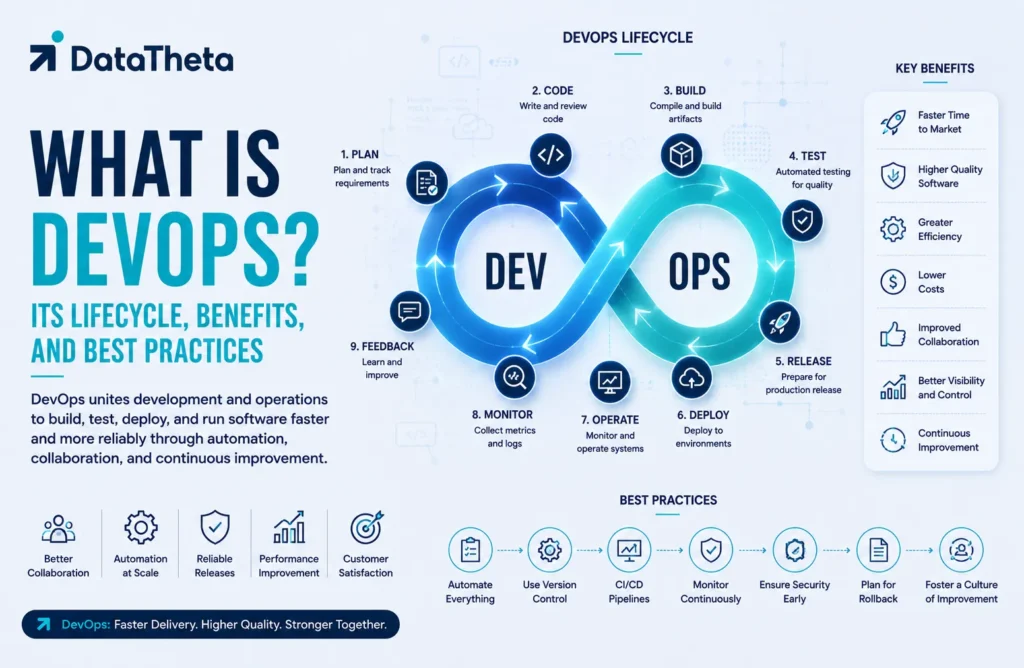
DevOps is a collaborative software delivery approach that combines development, operations, automation, and continuous improvement. It helps organisations build, test, release, monitor, and maintain applications more quickly and reliably. DevOps reduces barriers between teams by introducing shared ownership, automated workflows, continuous integration, continuous delivery, infrastructure as code, and rapid feedback. Businesses adopt DevOps to accelerate releases, improve software quality, strengthen security, reduce failures, and respond faster to customer needs. Its success depends on culture, standardised processes, suitable tools, governance, and measurable outcomes. This article explains DevOps, its lifecycle, core practices, benefits, challenges, best practices, applications, and future importance across modern digital organisations and increasingly complex cloud-based enterprise technology environments worldwide.
1. What Is DevOps?
DevOps is a software development and operations approach that brings development, testing, security, and IT operations teams together. Its purpose is to deliver applications and technology services more quickly, reliably, and consistently.
Traditional software delivery often separates developers from operations teams. Developers create applications, while operations professionals deploy and maintain them. This separation can create communication gaps, slow releases, inconsistent environments, and unclear responsibility when problems occur.
DevOps replaces isolated workflows with shared ownership and continuous collaboration. Teams automate repetitive activities, test changes frequently, monitor applications after deployment, and use operational feedback to improve future releases.
DevOps is not a single tool or technology. It is a combination of culture, processes, automation, technical practices, and measurable outcomes.
1.1) Key Characteristics of DevOps
- Encourages collaboration between development and operations teams.
- Automates software building, testing, deployment, and monitoring.
- Supports frequent and incremental application releases.
- Maintains consistent development and production environments.
- Uses continuous feedback to improve software quality.
- Applies shared responsibility for application performance.
- Integrates security throughout the development lifecycle.
- Measures delivery speed, reliability, failures, and recovery.
2. Why Is DevOps Important?
Modern organisations depend on digital applications to serve customers, manage operations, process transactions, and deliver products. Business requirements can change rapidly, making long and infrequent software releases difficult to manage.
Traditional delivery methods may involve manual testing, delayed approvals, inconsistent configurations, and limited coordination between teams. These problems increase the risk of deployment failures and slow responses to customer needs.
DevOps creates a faster and more controlled delivery process. Automation reduces human error, while smaller releases make problems easier to identify and correct.
The approach also improves operational reliability by making monitoring, incident response, security, and recovery part of software development.
2.1) Business Problems Addressed by DevOps
- Software releases take too long to reach users.
- Development and operations teams work in isolation.
- Manual deployments create inconsistent environments.
- Application failures are difficult to diagnose.
- Large releases introduce significant operational risk.
- Security checks occur late in development.
- Teams lack clear ownership of production performance.
- Infrastructure changes are undocumented or inconsistent.
- Customer feedback takes too long to influence improvements.
- Recovery from failed releases requires excessive time.
3. What Is the DevOps Lifecycle?
The DevOps lifecycle is a continuous process that covers software planning, development, testing, release, deployment, operation, monitoring, and improvement.
3.1) Planning
Teams define business requirements, user needs, technical objectives, priorities, and expected outcomes.
Planning should break large projects into smaller and manageable tasks that can be developed, tested, and delivered incrementally.
3.2) Development
Developers write application code and maintain it within version-control systems. Teams use shared coding standards, reusable components, and peer reviews to improve consistency.
Version control records every change and allows teams to collaborate, compare updates, and restore previous versions when required.
3.3) Continuous Integration
Continuous integration automatically combines code changes into a shared repository. Each update triggers automated checks to confirm that new code integrates correctly with the existing application.
Common checks include:
- Code-quality analysis
- Unit testing
- Dependency checks
- Security scanning
- Build verification
- Configuration validation
- Integration testing
3.4) Testing
Automated and manual tests verify whether the application meets functional, performance, security, and usability requirements.
Testing should occur throughout development rather than only before a major release.
3.5) Continuous Delivery and Deployment
Continuous delivery prepares approved changes for production through automated workflows. Continuous deployment automatically releases changes after they pass required controls.
Organisations may still require manual approval for sensitive, regulated, or high-risk releases.
3.6) Operations and Monitoring
After deployment, operations teams monitor application availability, performance, infrastructure, security, and user experience.
Monitoring provides information about errors, slow transactions, resource usage, and service disruptions.
3.7) Continuous Feedback and Improvement
Teams review monitoring information, incidents, customer feedback, and delivery metrics. These insights are used to improve code, processes, infrastructure, testing, and future releases.
4. Core Practices and Components of DevOps
DevOps combines technical and operational practices that make software delivery more repeatable and reliable.
4.1) Version Control
Version-control systems track changes to source code, configuration files, infrastructure definitions, and documentation.
They support collaboration, traceability, approvals, and controlled rollback.
4.2) Continuous Integration and Continuous Delivery
CI/CD pipelines automate code integration, testing, packaging, approval, and deployment.
They reduce manual effort and allow teams to release smaller changes more frequently.
4.3) Infrastructure as Code
Infrastructure as code manages servers, networks, databases, and cloud resources through version-controlled configuration files.
This creates repeatable environments and reduces manual configuration differences.
4.4) Configuration Management
Configuration management ensures that applications and infrastructure use approved settings across development, testing, and production environments.
It reduces configuration drift and supports reliable deployments.
4.5) Containers and Orchestration
Containers package applications with their required dependencies so they can operate consistently across environments.
Orchestration platforms manage container deployment, scaling, availability, networking, and recovery.
4.6) Monitoring and Observability
Monitoring tracks predefined performance and availability measures. Observability combines logs, metrics, traces, and events to help teams understand system behaviour.
These capabilities support faster problem detection and root-cause analysis.
4.7) DevSecOps
DevSecOps integrates security into planning, coding, testing, deployment, and operations.
Automated security checks help teams identify vulnerabilities earlier and reduce the cost of correction.
5. Major Applications of DevOps
DevOps supports software delivery, infrastructure management, cloud adoption, and digital transformation across industries.
5.1) Web and Mobile Application Development
Development teams use DevOps to build, test, and release web and mobile applications frequently.
Automated pipelines help deliver new features and corrections without lengthy manual deployment processes.
5.2) Cloud Application Delivery
DevOps supports the provisioning, deployment, scaling, and monitoring of applications across public, private, and hybrid cloud environments.
Infrastructure as code improves consistency and repeatability.
5.3) Microservices Management
Microservices divide applications into smaller independently deployable services.
DevOps practices help teams test, deploy, monitor, and scale these services without releasing the entire application together.
5.4) Enterprise Software Modernisation
Organisations use DevOps while modernising legacy systems, adopting APIs, moving applications to the cloud, and introducing new digital services.
Incremental delivery reduces transformation risk.
5.5) Automated Infrastructure Management
Infrastructure teams automate resource provisioning, configuration, patching, scaling, and recovery.
This reduces manual administration and improves environment consistency.
5.6) Continuous Security and Compliance
DevSecOps practices automate vulnerability scanning, policy checks, dependency reviews, audit evidence, and access validation.
These controls help organisations address security throughout delivery.
5.7) Data and AI Platform Operations
DevOps supports the software, infrastructure, APIs, and cloud services used by data engineering, analytics, machine learning, and artificial intelligence environments.
6. Top 7 Benefits of DevOps
DevOps can improve software delivery, operational reliability, collaboration, and customer responsiveness.
6.1) Faster Software Delivery
Automation and incremental development reduce the time required to build, test, approve, and release application changes.
Businesses can introduce features and improvements more quickly.
6.2) Improved Software Quality
Continuous testing identifies defects earlier in development. Smaller changes are easier to review, validate, and correct than large releases.
6.3) Greater Deployment Reliability
Standardised pipelines, infrastructure as code, automated validation, and controlled releases reduce configuration errors and deployment failures.
6.4) Better Team Collaboration
Shared workflows and responsibilities improve communication between development, testing, security, and operations teams.
This reduces delays caused by isolated departments and unclear ownership.
6.5) Faster Incident Recovery
Monitoring, automated rollback, documented configurations, and smaller releases help teams identify and resolve production problems more quickly.
6.6) Stronger Scalability and Efficiency
Automated infrastructure and cloud services allow applications to scale according to demand.
Teams spend less time on repetitive administration and more time improving services.
6.7) Improved Customer Experience
Faster updates, higher availability, fewer defects, and rapid incident resolution create more dependable digital experiences for customers.
7. Common DevOps Challenges
DevOps initiatives may fail when organisations adopt tools without changing culture, ownership, and working practices.
7.1) Organisational Resistance
Teams may resist shared responsibilities, automation, or changes to established approval processes.
Leadership support and clear communication are required to encourage adoption.
7.2) Siloed Teams
Development, operations, security, and testing teams may continue to work independently even after new tools are introduced.
DevOps requires shared objectives and cross-functional collaboration.
7.3) Legacy Systems
Older applications may not support automated testing, modern deployment methods, containers, or cloud infrastructure.
These systems often require gradual modernisation.
7.4) Excessive Tool Complexity
Using too many disconnected tools can create fragmented workflows and high maintenance costs.
Organisations should select tools that integrate effectively and support clear requirements.
7.5) Limited Automation
Manual testing, approvals, provisioning, and deployment prevent teams from achieving faster and more reliable delivery.
7.6) Security and Compliance Concerns
Rapid releases can create risk when security controls are not integrated into pipelines.
Sensitive changes may still require documented approvals and human review.
7.7) Difficulty Measuring Success
Release frequency alone does not demonstrate business value.
Organisations should also measure reliability, recovery, quality, customer outcomes, and team efficiency.
8. DevOps Best Practices
Successful DevOps adoption requires gradual improvement, strong collaboration, reliable automation, and measurable objectives.
8.1) Build a Collaborative Culture
Create cross-functional teams that share responsibility for development, deployment, security, reliability, and customer outcomes.
8.2) Automate Repetitive Processes
Automate building, testing, provisioning, configuration, deployment, monitoring, and recovery wherever practical.
Automation should remain transparent and controlled.
8.3) Use Small and Frequent Releases
Smaller updates reduce deployment risk and make defects easier to isolate.
Teams can collect feedback and make improvements more quickly.
8.4) Maintain Everything in Version Control
Store application code, infrastructure definitions, configurations, scripts, and documentation in controlled repositories.
Changes should be reviewed and traceable.
8.5) Integrate Security Early
Include code scanning, dependency analysis, secret detection, access validation, and compliance checks throughout development.
8.6) Implement Continuous Monitoring
Track application availability, latency, errors, infrastructure, security, user experience, and business transactions.
Alerts should be meaningful and connected to clear response procedures.
8.7) Design for Failure and Recovery
Use backups, redundancy, automated rollback, failover, health checks, and disaster-recovery procedures.
Teams should test recovery processes regularly.
8.8) Standardise Environments
Use containers, infrastructure as code, configuration management, and reusable deployment templates to reduce environmental differences.
8.9) Measure Delivery and Reliability
Monitor indicators such as:
- Deployment frequency
- Lead time for changes
- Change failure rate
- Mean time to recovery
- Application availability
- Defect rates
- Customer satisfaction
- Infrastructure costs
9. DevOps, DataOps, MLOps, and AIOps
These operating approaches use related automation and collaboration principles but focus on different technology areas.
9.1) Role of DevOps
DevOps manages software development, testing, deployment, infrastructure, and application operations.
9.2) Role of DataOps
DataOps applies similar practices to data pipelines, transformations, quality, analytics, and data products.
9.3) Role of MLOps
MLOps manages machine learning development, deployment, monitoring, retraining, governance, and retirement.
9.4) Role of AIOps
AIOps applies artificial intelligence and automation to IT monitoring, incident management, root-cause analysis, and operational reliability.
9.5) Relationship Between the Approaches
DevOps supports software and infrastructure, DataOps manages reliable data delivery, MLOps controls production models, and AIOps improves technology operations.
These practices often work together in modern enterprise environments.
10. Future of DevOps
DevOps is becoming more automated, secure, intelligent, and platform-oriented.
10.1) AI-Assisted Software Delivery
Artificial intelligence can support code generation, testing, incident analysis, documentation, and deployment recommendations.
Human review remains necessary for security, architecture, and production changes.
10.2) Platform Engineering
Platform engineering creates standard internal platforms that provide reusable development, deployment, security, and infrastructure capabilities.
This helps developers access approved tools without managing every operational detail.
10.3) Greater DevSecOps Adoption
Security and compliance controls will become more deeply integrated into development pipelines and infrastructure workflows.
10.4) Intelligent Observability
Monitoring platforms will use AI to correlate events, identify anomalies, summarise incidents, and recommend corrective actions.
10.5) Increased Automation and Self-Service
Teams will use self-service infrastructure, reusable templates, automated environments, and policy-based deployment controls to improve speed and consistency.
Conclusion
DevOps combines culture, collaboration, automation, continuous integration, delivery, monitoring, and feedback to improve software development and operations. Its lifecycle covers planning, coding, testing, deployment, operation, and continuous improvement. Organisations apply DevOps to cloud applications, mobile services, microservices, infrastructure management, security, modernisation, and AI platforms. Its benefits include faster delivery, improved quality, reliable deployments, stronger collaboration, quicker recovery, scalable operations, and better customer experiences. However, successful DevOps adoption requires shared ownership, standardised workflows, integrated security, version control, continuous monitoring, and measurable outcomes. Businesses that treat DevOps as an operating model rather than only a collection of tools can improve software reliability and respond faster to changing needs.