

Introduction
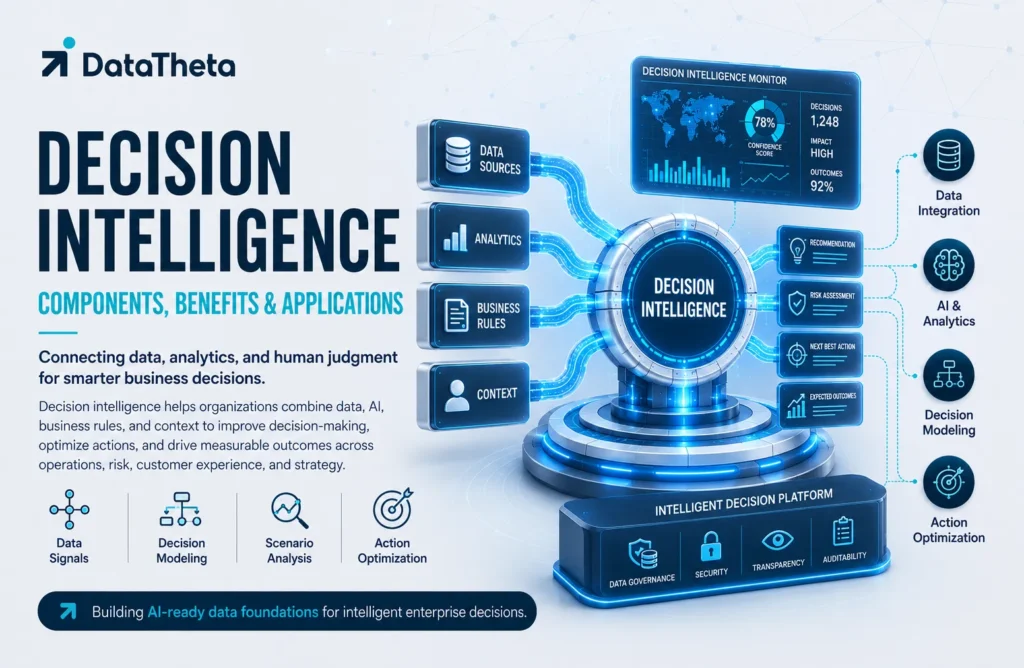
Decision intelligence is a structured approach to improving business decisions through data, analytics, artificial intelligence, behavioural science, and clearly defined decision processes. It helps organisations understand how decisions are made, what information is required, which outcomes matter, and where automation or human judgement should be applied. Unlike traditional analytics, which mainly explains data, decision intelligence connects insights directly to actions and measurable results. Organisations use it for pricing, risk management, customer engagement, supply chains, finance, operations, and strategic planning. Its effectiveness depends on reliable data, suitable models, transparent rules, governance, feedback, and accountability. This article explains decision intelligence, its components, benefits, applications, challenges, best practices, and future importance across industries.
1. What Is Decision Intelligence?
Decision intelligence is a discipline that combines data, analytics, artificial intelligence, business knowledge, behavioural science, and decision modelling to improve how organisations make choices.
It examines the complete decision process rather than focusing only on reports or predictions. This process includes identifying a decision, understanding available options, defining desired outcomes, evaluating risks, selecting an action, and measuring the result.
Traditional analytics may show what happened or predict what could happen. Decision intelligence goes further by connecting these insights with practical actions. It helps decision-makers understand what should be done, why a particular action is suitable, and how its effect will be measured.
1.1) Key Characteristics of Decision Intelligence
- Focuses on decisions rather than data alone.
- Connects insights with actions and outcomes.
- Combines human judgement with analytical models.
- Uses business rules, forecasts, simulations, and optimisation.
- Makes decision logic more visible and repeatable.
- Includes uncertainty, constraints, risks, and trade-offs.
- Supports manual, assisted, and automated decisions.
- Uses feedback to improve future decision performance.
2. Why Is Decision Intelligence Important?
Organisations make thousands of strategic, operational, and customer-related decisions. These decisions may involve pricing, lending, inventory, marketing, hiring, procurement, fraud, and resource allocation.
However, important decisions are often made through disconnected reports, personal experience, incomplete information, or inconsistent rules. Different employees may reach different conclusions even when reviewing similar situations.
Decision intelligence creates a structured framework for improving these choices. It brings together relevant information, analytical findings, business objectives, policies, and human expertise.
It also helps organisations determine which decisions should remain human-led, which should receive AI-assisted recommendations, and which may be safely automated.
2.1) Business Problems Addressed by Decision Intelligence
- Decisions rely heavily on intuition or incomplete information.
- Departments apply inconsistent rules to similar cases.
- Analytical insights do not lead to clear actions.
- Employees cannot explain why decisions were made.
- Automated systems optimise the wrong business measure.
- Teams overlook risks, constraints, and trade-offs.
- Decision outcomes are not measured consistently.
- Models and reports remain disconnected from workflows.
- Slow approval processes delay operational responses.
- Organisations repeat poor decisions without learning from results.
3. How Does Decision Intelligence Work?
Decision intelligence follows a structured process that connects a business decision with evidence, models, actions, and measurable outcomes.
3.1) Define the Decision
The first step is defining the specific choice that must be made. Teams should identify:
- The decision-maker
- Available options
- Required timing
- Desired outcome
- Constraints and policies
- Affected stakeholders
- Acceptable level of risk
- Measures of success
For example, a retailer may need to decide how much inventory to order for a particular location and period.
3.2) Map the Decision Process
Decision mapping documents the factors, assumptions, dependencies, rules, and consequences involved in making the choice.
It helps teams identify where information is missing, where delays occur, and where human judgement or automation is required.
3.3) Collect and Prepare Information
Relevant information is gathered from applications, databases, reports, external sources, and expert knowledge.
Data should be accurate, complete, timely, and appropriate for the decision. Poor-quality information can create unreliable recommendations regardless of model sophistication.
3.4) Analyse Options and Outcomes
Analytics, machine learning, simulations, and optimisation methods are used to evaluate available options.
The analysis may estimate demand, predict risk, calculate costs, simulate scenarios, or recommend an action according to defined objectives.
3.5) Execute the Decision
The selected action is incorporated into a workflow, application, dashboard, or automated system.
Depending on the risk level, the decision may be made by a person, recommended by an AI system, or executed automatically.
3.6) Measure and Improve
Teams track the result and compare it with the expected outcome.
Feedback is used to update data, models, assumptions, rules, and decision processes.
4. Core Components of Decision Intelligence
Decision intelligence combines several technical, analytical, and organisational components.
4.1) Data Foundation
Reliable decisions require accurate, integrated, accessible, and governed information.
The data foundation may include operational systems, warehouses, lakehouses, external data, metadata, and quality controls.
4.2) Decision Models
Decision models represent the logic connecting information, options, actions, and outcomes.
They may include business rules, decision trees, scorecards, causal diagrams, forecasts, simulations, and optimisation models.
4.3) Analytics and Artificial Intelligence
Analytics describes patterns, explains outcomes, predicts future events, and recommends suitable actions.
Artificial intelligence helps evaluate complex situations, process large datasets, and generate recommendations at scale.
4.4) Business Rules and Constraints
Business rules define requirements that decisions must follow, such as credit limits, regulatory policies, inventory thresholds, or approval conditions.
Constraints may include budgets, capacity, time, risk tolerance, and resource availability.
4.5) Human Judgement
Human expertise remains important when decisions involve uncertainty, ethics, unusual circumstances, or strategic considerations.
Decision intelligence should support human judgement rather than remove it without justification.
4.6) Feedback and Learning
Feedback compares predicted outcomes with actual results.
This allows organisations to improve models, rules, workflows, and future decisions continuously.
4.7) Governance and Accountability
Governance defines who owns the decision, who approves models, what information may be used, and how outcomes are monitored.
It also supports explainability, fairness, compliance, and auditability.
5. Types of Decisions Supported by Decision Intelligence
Decision intelligence can improve decisions across different levels of an organisation.
5.1) Strategic Decisions
Strategic decisions affect long-term direction, investment, market entry, product development, acquisitions, and organisational priorities.
These decisions usually require significant human judgement and scenario analysis.
5.2) Tactical Decisions
Tactical decisions translate strategy into departmental plans, budgets, campaigns, capacity targets, and resource allocations.
Decision intelligence helps managers compare options and coordinate activities.
5.3) Operational Decisions
Operational decisions occur frequently and support everyday business processes.
Examples include approving transactions, scheduling deliveries, prioritising support cases, and replenishing inventory.
5.4) Automated Decisions
High-volume and repeatable decisions may be automated when rules, data, risks, and controls are clearly defined.
Examples include routing requests, detecting suspicious activity, or adjusting system resources.
High-impact automated decisions should include monitoring, explanations, and escalation procedures.
6. Major Applications of Decision Intelligence
Decision intelligence supports planning, risk management, customer engagement, and operational improvement across industries.
6.1) Pricing and Revenue Management
Businesses analyse demand, customer behaviour, competition, inventory, and costs to recommend suitable prices.
Decision models can balance revenue, profit, demand, and customer experience.
6.2) Supply Chain Planning
Organisations use decision intelligence to determine inventory levels, supplier choices, production schedules, and delivery routes.
It helps teams consider demand forecasts, capacity, lead times, costs, and disruption risks.
6.3) Credit and Risk Decisions
Banks and financial institutions combine customer information, risk models, policies, and human review to support lending decisions.
Governance and explainability are especially important in these applications.
6.4) Customer Engagement
Businesses determine which message, offer, product, or service action is most suitable for each customer.
Decision intelligence connects predictions with personalised actions and measurable outcomes.
6.5) Fraud and Security Management
Organisations evaluate transactions, behaviour, device information, and historical patterns to identify suspicious activity.
The system may approve, block, escalate, or request further verification.
6.6) Workforce and Resource Planning
Decision intelligence supports staffing, scheduling, recruitment, training, and workload allocation.
It helps balance demand, employee availability, skills, costs, and service targets.
6.7) Healthcare Decision Support
Healthcare organisations use decision intelligence to support resource planning, patient prioritisation, treatment recommendations, and operational scheduling.
Clinical professionals should retain appropriate oversight over high-impact decisions.
7. Top 7 Benefits of Decision Intelligence
Decision intelligence helps organisations make faster, more consistent, and more accountable choices.
7.1) Better Decision Quality
Decision-makers receive relevant information, forecasts, alternatives, and expected outcomes within a structured process.
7.2) Faster Decision-Making
Automated analysis and defined workflows reduce the time required to collect information, compare options, and obtain approvals.
7.3) Greater Consistency
Shared models, rules, and definitions help teams apply similar standards across departments, locations, and customer interactions.
7.4) Improved Transparency
Documented decision logic helps users understand which information, assumptions, and rules influenced an outcome.
7.5) Stronger Risk Management
Scenario analysis, predictive models, and constraints help organisations identify potential risks before selecting an action.
7.6) More Effective Automation
Decision intelligence connects automation with clear objectives, governance, and performance measures.
This reduces the risk of automating poorly designed decisions.
7.7) Continuous Organisational Learning
Feedback allows organisations to compare expected and actual outcomes and improve future decisions.
8. Common Decision Intelligence Challenges
Decision intelligence can produce limited value when data, models, ownership, or business objectives are unclear.
8.1) Poor Data Quality
Inaccurate, incomplete, duplicated, or outdated information can create unreliable recommendations.
8.2) Unclear Decision Objectives
Teams may optimise a convenient metric instead of the actual business outcome.
For example, maximising sales may reduce profitability or increase service costs.
8.3) Complex Decision Processes
Some decisions involve many stakeholders, regulations, dependencies, and conflicting objectives.
Simplifying these processes requires strong business participation.
8.4) Model Bias and Limited Explainability
Models may reproduce historical bias or generate recommendations users cannot understand.
Fairness, transparency, and validation must match the risk level.
8.5) Resistance to Change
Employees may distrust analytical recommendations or fear that automation will replace their judgement.
Clear communication and gradual implementation can improve adoption.
8.6) Weak Workflow Integration
Recommendations create little value when users must leave their normal applications or perform additional manual work.
8.7) Lack of Accountability
Unclear ownership makes it difficult to determine who should approve, monitor, or correct a decision system.
9. Decision Intelligence Best Practices
Successful decision intelligence combines business clarity, reliable data, suitable technology, and responsible governance.
9.1) Begin with a Specific Decision
Focus on a clearly defined decision rather than starting with available data or technology.
9.2) Define Measurable Outcomes
Establish how success will be measured through revenue, cost, risk, customer experience, speed, quality, or operational performance.
9.3) Map the Complete Decision Process
Document inputs, options, rules, stakeholders, constraints, actions, and expected consequences.
9.4) Combine Data with Business Knowledge
Analytical models should incorporate operational expertise, policies, market context, and practical limitations.
9.5) Maintain Human Oversight
Use appropriate review, escalation, and override controls for uncertain, unusual, or high-impact decisions.
9.6) Test Decisions Before Scaling
Use pilots, simulations, controlled experiments, and scenario analysis to evaluate recommendations before wider implementation.
9.7) Integrate Recommendations into Workflows
Deliver insights within the applications and processes where users already make decisions.
9.8) Monitor Outcomes Continuously
Track model performance, decision quality, user behaviour, fairness, costs, and actual business results.
9.9) Establish Governance and Ownership
Assign accountable owners and document approval, access, validation, monitoring, and retirement procedures.
10. Decision Intelligence and Business Intelligence
Decision intelligence and business intelligence are related but focus on different stages of organisational decision-making.
10.1) Role of Business Intelligence
Business intelligence collects, models, and presents historical and current information through dashboards and reports.
It helps users understand what happened and monitor performance.
10.2) Role of Decision Intelligence
Decision intelligence connects information with specific choices, actions, constraints, and expected outcomes.
It helps determine what action should be considered and how its result will be evaluated.
10.3) Relationship Between the Two
Business intelligence provides visibility and context, while decision intelligence structures the process of converting insights into actions.
Organisations often use both together.
11. Future of Decision Intelligence
Decision intelligence is becoming more automated, real-time, explainable, and embedded within business applications.
11.1) AI-Assisted Decision-Making
Artificial intelligence will increasingly compare options, summarise evidence, explain trade-offs, and recommend actions.
11.2) Real-Time Decision Systems
Streaming data will support immediate decisions in fraud detection, pricing, logistics, customer service, and digital operations.
11.3) Generative AI Interfaces
Users will interact with decision systems through natural-language questions, scenario exploration, and conversational explanations.
11.4) Decision Automation with Guardrails
More repeatable decisions will be automated within defined limits, approval rules, and monitoring controls.
11.5) Stronger Decision Governance
Organisations will develop formal standards for decision ownership, model validation, fairness, explainability, and accountability.
Conclusion
Decision intelligence combines data, analytics, artificial intelligence, business rules, behavioural science, and human judgement to improve organisational decisions. It defines choices clearly, evaluates available options, connects insights with actions, and measures outcomes through continuous feedback. Organisations apply it to pricing, supply chains, lending, customer engagement, fraud management, workforce planning, and healthcare. Its benefits include better quality, faster decisions, greater consistency, improved transparency, stronger risk management, effective automation, and continuous learning. However, successful implementation requires reliable data, clear objectives, workflow integration, human oversight, and accountable governance. Organisations that manage decisions as measurable business assets can turn analytical insights into more consistent and valuable outcomes.