


Introduction
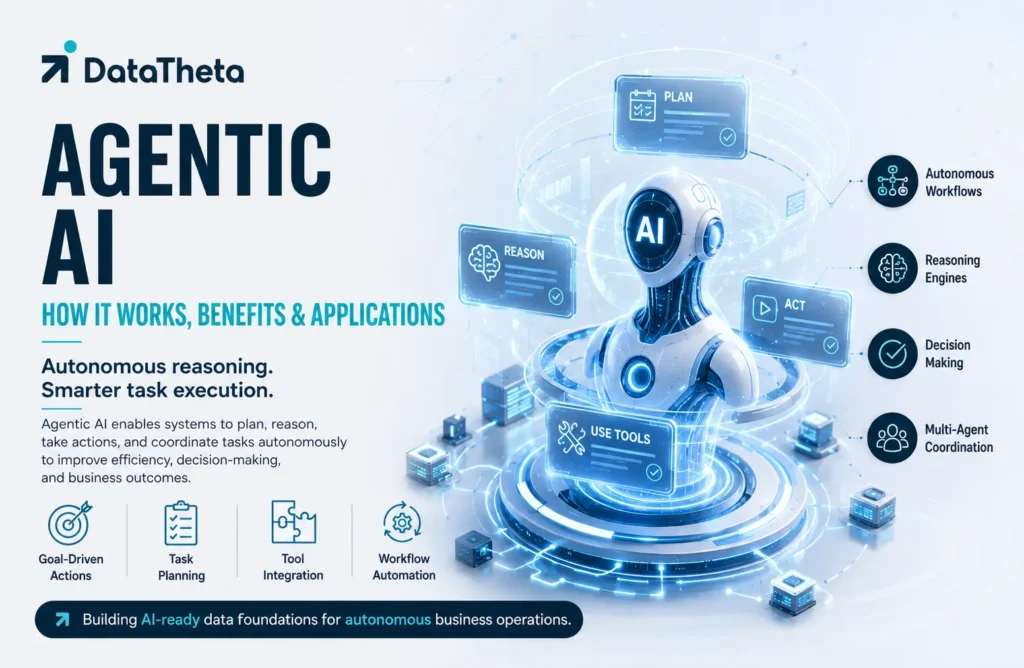
Agentic AI refers to artificial intelligence systems that can understand goals, plan actions, use tools, make decisions, and complete multi-step tasks with limited human intervention. Unlike traditional AI models that mainly respond to prompts, agentic systems can evaluate situations, select suitable actions, monitor progress, and adjust their approach when conditions change. Businesses are exploring agentic AI for customer service, software development, finance, supply chains, research, cybersecurity, and operational automation. Its value depends on reliable data, controlled system access, clear objectives, governance, monitoring, and human oversight. This article explains what agentic AI is, how it works, its components, applications, benefits, risks, implementation practices, and future business impact across modern enterprise environments.
1. What Is Agentic AI?
Agentic AI is a form of artificial intelligence designed to pursue defined goals by planning and completing actions rather than only generating a single response. An agent can interpret an objective, break it into smaller tasks, select tools, retrieve information, execute steps, evaluate results, and revise its approach.
Many agentic systems use large language models for reasoning and communication, but they may also include rules, machine learning models, databases, APIs, workflow engines, and specialised software. Their level of autonomy varies. Some recommend actions for human approval, while others perform approved low-risk tasks automatically.
1.1) Key Characteristics of Agentic AI
- Works toward a defined goal or desired outcome.
- Breaks complex objectives into manageable steps.
- Uses tools, applications, and data sources.
- Maintains context across multi-step activities.
- Evaluates results and adjusts its next action.
- Operates within permissions, policies, and guardrails.
- Escalates uncertain or high-risk decisions to people.
2. How Does Agentic AI Work?
Agentic AI operates through a repeated cycle of understanding, planning, acting, observing, and improving. The exact design depends on the task, tools, risk level, and required human involvement.
2.1) Goal Interpretation
The agent receives a goal, instruction, or event. It identifies the intended outcome, available context, constraints, deadlines, and success criteria. Clear objectives reduce ambiguity and help the agent choose suitable actions.
2.2) Planning and Reasoning
The system divides the goal into smaller tasks and determines their order. It may compare different approaches, identify dependencies, and revise the plan when new information appears.
2.3) Tool Selection and Action
The agent uses approved tools such as search systems, databases, business applications, APIs, code environments, or communication platforms. It may retrieve records, create documents, update workflows, run analyses, or trigger authorised processes.
2.4) Memory and Context
Short-term memory helps the agent track the current task, while longer-term memory may preserve approved preferences, past actions, or useful information. Memory must be controlled to prevent incorrect, outdated, or sensitive information from influencing decisions.
2.5) Feedback and Adaptation
After each action, the agent checks the result against its objective. It may continue, retry, change direction, request approval, or escalate the task. Monitoring and feedback help prevent repeated errors and uncontrolled behaviour.
3. Major Types of AI Agents
AI agents can be grouped according to how they make decisions and coordinate tasks.
3.1) Reactive Agents
Reactive agents respond to current inputs using predefined rules or learned patterns. They are suitable for simple, predictable activities that do not require extensive planning.
3.2) Goal-Based Agents
Goal-based agents assess possible actions according to a target outcome. They can plan several steps and change their approach when conditions shift.
3.3) Learning Agents
Learning agents improve their performance using feedback, outcomes, or new data. Their updates require validation so that undesirable behaviour is not reinforced.
3.4) Multi-Agent Systems
Multi-agent systems use several specialised agents that collaborate, delegate tasks, or review one another. Coordination controls are essential to prevent duplicated work, conflicting actions, and unnecessary cost.
4. Core Components of Agentic AI
An effective agentic system combines intelligence, memory, tools, controls, and operational monitoring.
4.1) Reasoning Model
A reasoning model interprets instructions, creates plans, selects actions, and communicates results. It may be supported by specialised models for classification, forecasting, vision, or anomaly detection.
4.2) Memory and Knowledge
Memory preserves relevant context, while knowledge systems provide trusted information from documents, databases, and enterprise platforms. Retrieval controls help ensure that the agent uses current and authorised data.
4.3) Tools and Integrations
Tools allow the agent to act beyond conversation. Common integrations include CRM, ERP, ticketing, analytics, email, code repositories, and workflow systems.
4.4) Orchestration
Orchestration manages task order, dependencies, retries, time limits, approvals, and communication between agents or systems.
4.5) Guardrails and Monitoring
Guardrails restrict access, actions, data use, and spending. Monitoring records decisions, tool calls, errors, outcomes, and exceptions for review and auditing.
5. Major Applications of Agentic AI
Agentic AI can support multi-step activities that combine information gathering, reasoning, tool use, and action.
5.1) Customer Service
Agents can understand requests, retrieve customer records, identify solutions, draft responses, update tickets, and escalate complex cases. Human approval should remain available for sensitive or exceptional situations.
5.2) Software Development
Development agents can analyse requirements, generate code, run tests, identify defects, update documentation, and prepare changes for review. Engineers must validate security, architecture, licensing, and production readiness.
5.3) IT Operations and Cybersecurity
Agents can monitor systems, investigate alerts, collect diagnostic information, recommend fixes, and execute approved recovery actions. In cybersecurity, tightly controlled agents may help prioritise threats and coordinate responses.
5.4) Finance and Procurement
Agentic systems can support invoice review, reconciliation, expense checks, supplier analysis, reporting, and approval workflows. Strong controls are required before any financial transaction or contractual action.
5.5) Supply Chain and Logistics
Agents can evaluate demand, inventory, supplier performance, delivery status, and disruptions. They may recommend alternative suppliers, adjust plans, or initiate approved operational workflows.
5.6) Research and Knowledge Work
Research agents can gather information, compare sources, summarise findings, analyse documents, and organise evidence. Human reviewers should verify important claims and conclusions.
5.7) Sales and Marketing
Agents can research prospects, prepare account summaries, personalise outreach, schedule follow-ups, and update CRM records. Consent, communication rules, and brand standards must guide automated engagement.
6. Top 7 Benefits of Agentic AI
Agentic AI can create significant value when autonomy is matched with appropriate controls.
6.1) End-to-End Task Automation
Agents can coordinate several steps across different tools, reducing handoffs and manual workflow management.
6.2) Faster Execution
Agentic systems can gather information, analyse options, and complete approved activities more quickly than sequential manual processes.
6.3) Improved Employee Productivity
Employees can delegate repetitive research, documentation, coordination, and administrative work while focusing on judgement and higher-value decisions.
6.4) Continuous Operational Support
Agents can monitor systems and handle routine requests continuously, improving responsiveness outside normal working hours.
6.5) Greater Process Consistency
Defined workflows, policies, and validation rules help agents perform recurring activities consistently and maintain documented records.
6.6) Scalable Service Delivery
Organisations can manage more requests, transactions, and operational events without increasing manual effort at the same rate.
6.7) Better Decision Support
Agents can combine data from several sources, compare alternatives, and present recommendations with supporting context for human review.
7. Challenges and Responsible Agentic AI Practices
Agentic AI introduces greater risk than systems that only generate content because agents can take actions in connected environments.
7.1) Common Agentic AI Challenges
- Incorrect plans or actions based on incomplete context
- Unauthorised access to sensitive systems or information
- Cascading errors across connected tools and workflows
- Difficulty explaining complex decision sequences
- Excessive tool usage, processing cost, or repeated actions
- Manipulation through malicious prompts or external content
- Conflicting behaviour between multiple agents
- Overreliance on automation in high-risk situations
7.2) Responsible Agentic AI Best Practices
- Begin with narrow, measurable, and low-risk use cases.
- Apply least-privilege access to every connected system.
- Require human approval for sensitive or irreversible actions.
- Define task limits, budgets, timeouts, and escalation rules.
- Test agents in isolated environments before deployment.
- Record plans, actions, tool calls, and outcomes.
- Monitor accuracy, failures, drift, cost, and user behaviour.
- Provide immediate methods to pause or disable agents.
- Review permissions and knowledge sources regularly.
8. Agentic AI, Generative AI, and Traditional Automation
These technologies can work together, but they serve different purposes.
8.1) Relationship Between the Technologies
Generative AI creates content or responses from prompts. Agentic AI uses models, tools, memory, and workflows to pursue goals through multiple actions. Traditional automation follows predefined rules and process paths.
An agent may use generative AI to draft a message and traditional automation to update a system after approval.
8.2) Main Differences
- Generative AI primarily creates or transforms content.
- Agentic AI plans, acts, evaluates, and adapts.
- Traditional automation follows fixed instructions.
- Agents can respond to changing conditions and tool results.
- Greater autonomy requires stronger permissions and oversight.
- All three approaches can be combined in enterprise workflows.
9. Future of Agentic AI
Agentic AI is expected to become more specialised, collaborative, and integrated with enterprise operations.
9.1) Specialised Enterprise Agents
Organisations will deploy agents designed for specific functions, industries, and controlled processes. Specialisation can improve accuracy, governance, and cost management.
9.2) Multi-Agent Collaboration
Teams of agents may divide complex work into research, analysis, execution, and review tasks. Effective coordination will require shared context, clear authority, and conflict resolution.
9.3) Human-Agent Workflows
Future systems will increasingly involve people setting objectives, approving important actions, handling exceptions, and reviewing outcomes while agents manage routine execution.
9.4) Stronger Governance and Standards
Enterprises will establish formal policies for autonomy, permissions, accountability, testing, monitoring, and incident response. Regulatory expectations are also likely to influence high-risk deployments.
9.5) More Reliable and Efficient Agents
Improved models, memory systems, verification methods, and observability tools will help reduce errors and operating costs. Progress will depend on measurable reliability rather than autonomy alone.
Conclusion
Agentic AI extends artificial intelligence from generating responses to pursuing goals through planning, tool use, action, and feedback. Its applications include customer service, software development, IT operations, finance, supply chains, research, sales, and cybersecurity. The technology can automate multi-step work, accelerate execution, improve productivity, and scale operational support. However, greater autonomy also creates risks involving incorrect actions, data exposure, security, cost, and accountability. Successful adoption requires narrow objectives, controlled access, human approval, transparent monitoring, and reliable data. Organisations that introduce agents gradually and measure both outcomes and risks will be better positioned to achieve sustainable value from agentic AI.