


Introduction
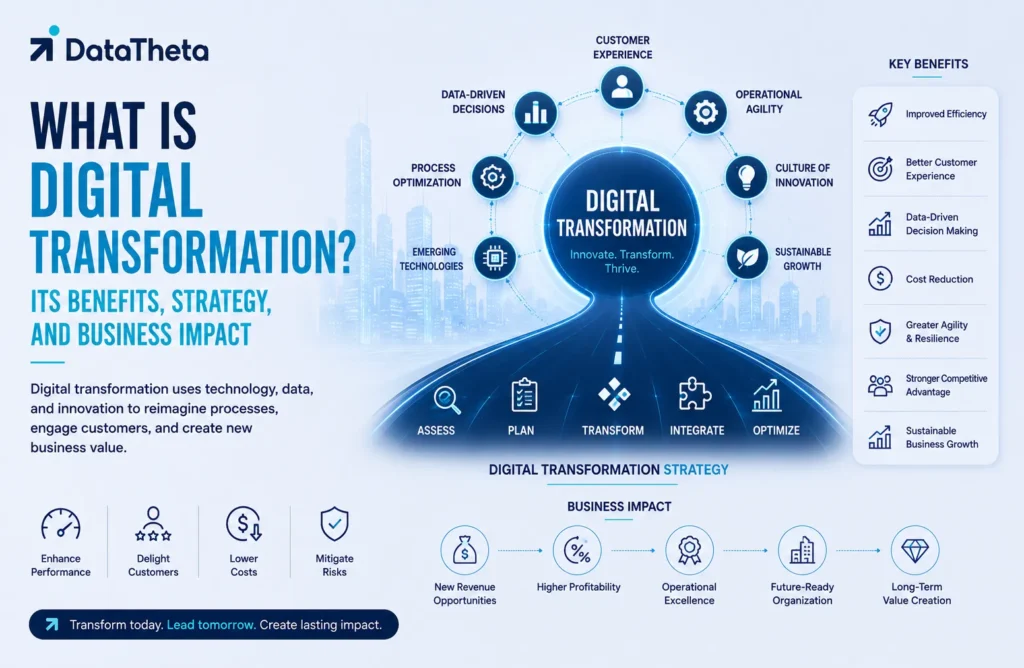
Digital transformation is the strategic use of digital technologies, data, automation, and new operating models to improve how an organisation works and delivers value. It goes beyond purchasing software by redesigning processes, customer experiences, products, services, and decision-making. Organisations pursue digital transformation to increase efficiency, respond faster to market change, improve customer engagement, strengthen resilience, and create new revenue opportunities. Successful transformation requires clear leadership, reliable data, modern platforms, skilled employees, governance, and measurable business objectives. This article explains what digital transformation is, its core components, strategy, technologies, applications, benefits, challenges, best practices, and long-term business impact across modern industries, enterprise operating environments, and increasingly competitive global markets worldwide today.
1. What Is Digital Transformation?
Digital transformation is the process of using technology, data, and organisational change to redesign business operations, customer experiences, products, services, and decision-making.
It is not limited to replacing paper processes with digital applications or moving infrastructure to the cloud. A complete transformation examines how an organisation creates value and identifies where technology can improve speed, quality, accessibility, scalability, and innovation.
Digital transformation may involve modernising legacy systems, automating workflows, integrating data, introducing artificial intelligence, developing digital channels, and changing how employees collaborate.
The objective is to create an organisation that can respond more effectively to customer expectations, operational risks, competitive pressure, and changing market conditions.
1.1) Key Characteristics of Digital Transformation
- Connects technology investments with business objectives.
- Redesigns processes rather than only digitising existing steps.
- Uses data to support faster and more reliable decisions.
- Improves customer and employee experiences.
- Introduces automation across repetitive business activities.
- Modernises applications, infrastructure, and data platforms.
- Encourages experimentation and continuous improvement.
- Requires leadership, governance, skills, and cultural change.
2. Why Is Digital Transformation Important?
Customer expectations, business models, technology platforms, and competitive conditions continue to evolve. Organisations that depend on outdated systems and manual processes may struggle to respond quickly.
Disconnected applications can create duplicated information, slow reporting, inconsistent customer service, and high operating costs. Legacy technology may also limit cloud adoption, automation, analytics, and artificial intelligence.
Digital transformation helps organisations address these limitations by creating connected processes, accessible information, scalable platforms, and more responsive services.
It can also improve resilience. Organisations with digital workflows, cloud infrastructure, automated controls, and real-time information are often better prepared to manage disruptions and changing demand.
2.1) Business Problems Addressed by Digital Transformation
- Legacy systems are expensive and difficult to maintain.
- Manual processes create delays, errors, and repeated work.
- Customer experiences vary across channels.
- Business information remains fragmented across departments.
- Employees lack suitable digital tools and timely information.
- Reporting and decision-making take too long.
- Products and services cannot adapt quickly to market change.
- Infrastructure cannot scale with business demand.
- Security and compliance controls remain inconsistent.
- Competitors introduce digital services more rapidly.
3. Core Components of Digital Transformation
Digital transformation combines technology, data, people, processes, and governance within a coordinated business programme.
3.1) Digital Strategy and Leadership
Leadership establishes the purpose, priorities, investment approach, and expected outcomes of transformation.
Executives should explain why change is necessary and ensure that technology initiatives support broader business strategy.
3.2) Business Process Transformation
Process transformation examines how work moves across departments, systems, employees, and customers.
Organisations simplify unnecessary steps, remove repeated data entry, automate approvals, and redesign workflows around desired outcomes.
3.3) Technology Modernisation
Modernisation may include replacing legacy applications, adopting cloud platforms, using APIs, introducing mobile services, and improving infrastructure.
Technology choices should support scalability, security, integration, and long-term maintainability.
3.4) Data and Analytics
Reliable data helps organisations understand customers, monitor operations, measure performance, forecast demand, and manage risk.
A strong data foundation includes integration, quality, governance, architecture, analytics, and accessible reporting.
3.5) Customer Experience
Digital transformation improves how customers discover, purchase, receive, and use products and services.
Organisations may introduce mobile applications, self-service portals, personalised communication, digital payments, and connected support channels.
3.6) Workforce and Culture
Employees require suitable tools, skills, incentives, and support to adopt new ways of working.
Cultural transformation encourages collaboration, experimentation, learning, and shared accountability for outcomes.
3.7) Governance, Security, and Risk
Governance defines ownership, investment priorities, standards, policies, and performance measures.
Security, privacy, compliance, resilience, and ethical technology use should be included throughout transformation.
4. Major Technologies Used in Digital Transformation
Digital transformation uses different technologies according to business requirements and organisational maturity.
4.1) Cloud Computing
Cloud platforms provide scalable infrastructure, databases, applications, storage, analytics, and artificial intelligence services.
They can reduce hardware dependency and accelerate the deployment of new capabilities.
4.2) Data Platforms and Analytics
Data warehouses, lakes, lakehouses, integration platforms, and business intelligence tools help organisations combine and analyse information.
These platforms provide the foundation for reporting, forecasting, and decision-making.
4.3) Artificial Intelligence and Machine Learning
AI and machine learning support prediction, classification, recommendations, document processing, customer service, and intelligent automation.
Their effectiveness depends on high-quality data, governance, and continuous monitoring.
4.4) Robotic Process Automation
Robotic process automation uses software bots to perform repetitive activities across digital applications.
It is commonly used for data entry, reporting, reconciliation, and administrative workflows.
4.5) Internet of Things
Connected devices collect information from equipment, vehicles, buildings, products, and infrastructure.
IoT data supports monitoring, predictive maintenance, energy management, and operational optimisation.
4.6) Application Programming Interfaces
APIs allow applications, partners, data platforms, and digital services to exchange information.
They make it easier to connect systems and develop reusable business capabilities.
4.7) Cybersecurity Technologies
Identity management, encryption, monitoring, threat detection, access controls, and recovery systems protect digital platforms and information.
Security must evolve as organisations introduce more connected systems and services.
5. How to Build a Digital Transformation Strategy
A digital transformation strategy provides a structured roadmap for connecting technology initiatives with measurable business outcomes.
5.1) Define the Transformation Vision
Leadership should define what the organisation aims to become and why transformation is required.
The vision may focus on customer experience, operational efficiency, new services, resilience, or data-driven decision-making.
5.2) Assess the Current Environment
Organisations should evaluate:
- Existing applications and infrastructure
- Manual and inefficient processes
- Data quality and accessibility
- Customer and employee experiences
- Technology costs and risks
- Skills and operating capabilities
- Security and compliance controls
- Current transformation initiatives
This assessment establishes a realistic starting point.
5.3) Prioritise Business Outcomes
Transformation priorities should be based on expected value, urgency, feasibility, risk, and strategic importance.
High-value opportunities may include reducing processing time, improving customer retention, lowering operating costs, or introducing digital revenue channels.
5.4) Design the Target Operating Model
The target operating model defines how people, processes, technology, data, and governance will work together in the future.
It should clarify ownership, decision rights, team structures, and service responsibilities.
5.5) Create a Transformation Roadmap
The roadmap divides transformation into manageable initiatives, milestones, dependencies, investments, and expected results.
Early projects should demonstrate value while establishing reusable capabilities for future programmes.
5.6) Implement and Scale
Organisations should test new processes and technologies through controlled pilots before wider deployment.
Successful approaches can then be standardised and expanded across departments, locations, and business units.
5.7) Measure and Improve
Transformation progress should be measured continuously.
Organisations should review outcomes, customer feedback, adoption, costs, risks, and operational performance before adjusting priorities.
6. Major Applications of Digital Transformation
Digital transformation supports customer engagement, operations, innovation, and organisational growth across industries.
6.1) Digital Customer Service
Businesses use self-service portals, chatbots, mobile applications, and connected support platforms to provide faster assistance.
Customer information can be shared across channels to create more consistent interactions.
6.2) Intelligent Process Automation
Organisations automate document processing, approvals, reconciliation, claims, customer onboarding, and administrative workflows.
Automation improves speed, accuracy, scalability, and traceability.
6.3) Data-Driven Decision-Making
Integrated data platforms provide dashboards, forecasts, alerts, and analytical insights.
Leaders can monitor performance and respond to risks or opportunities more quickly.
6.4) Supply Chain Transformation
Manufacturers and retailers connect suppliers, inventory, production, logistics, and customer demand.
Real-time information supports planning, tracking, and disruption management.
6.5) Digital Products and Services
Organisations create mobile services, subscription platforms, connected products, digital marketplaces, and personalised experiences.
These offerings can generate new revenue and strengthen customer relationships.
6.6) Workforce Collaboration
Cloud applications, digital workplaces, knowledge platforms, and workflow tools help employees collaborate across locations.
They also improve access to information and reduce administrative effort.
6.7) Predictive Operations
Analytics, sensors, and machine learning help organisations predict demand, equipment failures, customer behaviour, and operational risks.
This supports proactive planning and preventive action.
7. Top 7 Benefits of Digital Transformation
Digital transformation can improve efficiency, responsiveness, innovation, and long-term competitiveness.
7.1) Greater Operational Efficiency
Automated and redesigned processes reduce manual work, delays, duplicated effort, and processing errors.
7.2) Improved Customer Experience
Connected channels, personalised services, faster responses, and self-service capabilities make interactions more convenient and consistent.
7.3) Better Decision-Making
Integrated data and analytics provide timely information about customers, operations, finances, risks, and market conditions.
7.4) Increased Agility
Modern platforms and flexible processes allow organisations to introduce changes, products, and services more quickly.
7.5) New Revenue Opportunities
Digital products, subscriptions, platforms, data services, and connected experiences can create additional income sources.
7.6) Stronger Resilience
Cloud infrastructure, automated workflows, remote access, backups, and real-time monitoring help organisations respond to disruption.
7.7) Improved Employee Productivity
Modern tools and automation reduce repetitive activities and help employees access information, collaborate, and complete work efficiently.
8. Common Digital Transformation Challenges
Digital transformation programmes may fail when organisations focus on technology without addressing business processes, employees, and governance.
8.1) Unclear Business Objectives
Projects may introduce new technology without defining the problem, expected outcome, or success measure.
8.2) Resistance to Change
Employees may resist unfamiliar systems, responsibilities, or workflows.
Communication, training, participation, and leadership support are essential.
8.3) Legacy Technology
Older systems may be difficult to integrate, secure, or replace.
Modernisation may require phased migration and temporary hybrid environments.
8.4) Poor Data Quality
Inaccurate, duplicated, or fragmented data reduces the value of analytics, automation, and artificial intelligence.
8.5) Skills Shortages
Transformation requires expertise in cloud platforms, data, cybersecurity, process design, product management, and organisational change.
8.6) Fragmented Initiatives
Departments may adopt separate technologies without common standards or architecture.
This can create new silos and duplicated costs.
8.7) Cybersecurity and Privacy Risks
Expanding digital services increases the number of systems, users, devices, and connections that must be protected.
9. Digital Transformation Best Practices
Successful transformation combines strategic clarity, incremental delivery, employee involvement, and continuous governance.
9.1) Focus on Business Value
Begin with customer, operational, financial, or strategic outcomes rather than individual technologies.
9.2) Secure Executive Sponsorship
Senior leaders should provide direction, resources, accountability, and support for organisational change.
9.3) Modernise Incrementally
Divide large programmes into smaller initiatives that deliver measurable value and reduce implementation risk.
9.4) Build a Strong Data Foundation
Improve data integration, quality, governance, security, metadata, and accessibility before scaling analytics and AI.
9.5) Design Around Users
Include customers and employees in process design, testing, and feedback.
Digital solutions should make important activities simpler and more effective.
9.6) Invest in Skills and Change Management
Provide training, communication, role clarity, and practical support throughout the transformation process.
9.7) Apply Security by Design
Include identity management, privacy, access controls, monitoring, resilience, and compliance from the beginning.
9.8) Establish Clear Governance
Define programme ownership, technology standards, investment priorities, decision rights, and performance measures.
9.9) Measure Outcomes Continuously
Track adoption, processing time, customer satisfaction, revenue, costs, reliability, risk, and employee productivity.
10. Business Impact of Digital Transformation
The effect of digital transformation extends beyond technology departments and can reshape the entire organisation.
10.1) Operational Impact
Automation, integrated systems, and real-time information improve process speed, quality, and scalability.
10.2) Financial Impact
Transformation can reduce operating costs, improve revenue, strengthen forecasting, and support more efficient resource allocation.
10.3) Customer Impact
Digital channels, personalisation, and faster service improve convenience, satisfaction, and loyalty.
10.4) Workforce Impact
Employees may move from repetitive administrative tasks towards analytical, creative, technical, and customer-focused responsibilities.
10.5) Strategic Impact
Modern digital capabilities allow organisations to enter new markets, introduce different business models, and respond more quickly to competitors.
11. Future of Digital Transformation
Digital transformation will continue to evolve as artificial intelligence, automation, and connected technologies become more capable.
11.1) AI-Driven Organisations
Artificial intelligence will increasingly support customer interactions, decision-making, content creation, forecasting, and operational automation.
11.2) Intelligent and Autonomous Processes
AI agents and automation platforms will coordinate broader workflows across applications, data, and employees.
Strong permissions, monitoring, and human oversight will remain necessary.
11.3) Composable Digital Platforms
Organisations will assemble reusable APIs, cloud services, data products, and modular applications to introduce capabilities more quickly.
11.4) Real-Time Enterprises
Streaming data, connected devices, and automated decisions will allow organisations to respond immediately to customers and operational events.
11.5) Continuous Transformation
Digital transformation will become an ongoing organisational capability rather than a one-time programme.
Businesses will continually evaluate technologies, processes, skills, and customer expectations.
Conclusion
Digital transformation uses technology, data, automation, and organisational change to improve how businesses operate and deliver value. It includes process redesign, technology modernisation, data management, customer experience, workforce development, and governance. Organisations apply it to customer service, automation, analytics, supply chains, digital products, collaboration, and predictive operations. Its benefits include greater efficiency, improved customer experience, better decisions, increased agility, new revenue, stronger resilience, and higher employee productivity. However, successful transformation requires clear objectives, executive support, reliable data, employee participation, security, and measurable outcomes. Organisations that treat digital transformation as a continuous business strategy can respond more effectively to change and build sustainable competitive advantage.