

Introduction
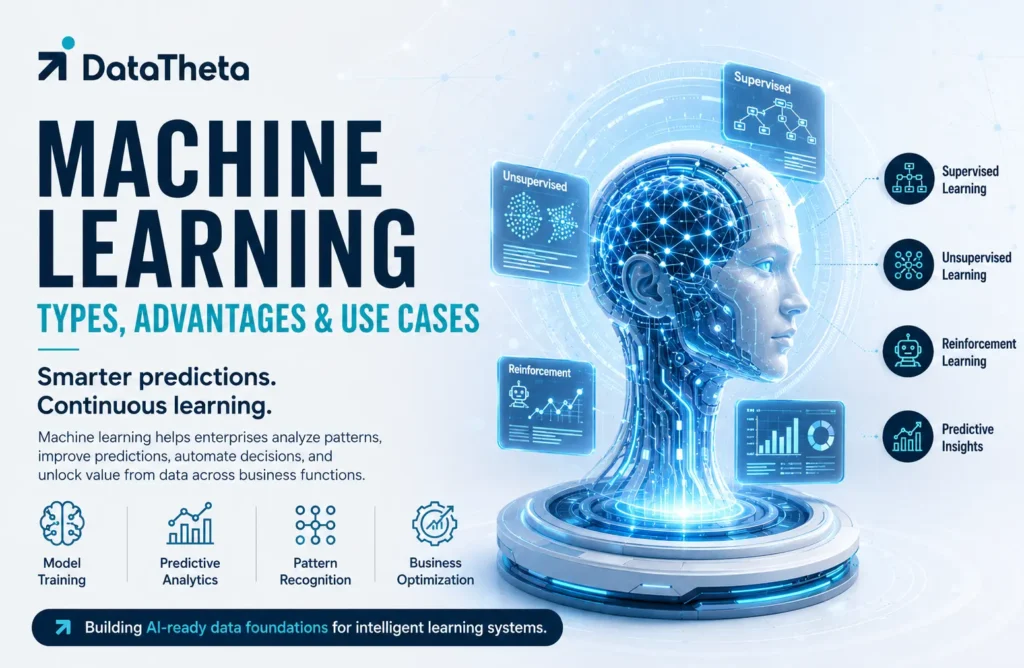
Machine learning is a branch of artificial intelligence that enables computer systems to identify patterns, learn from data, and improve their performance without being explicitly programmed for every situation. It helps organisations automate decisions, predict outcomes, personalise experiences, detect anomalies, and analyse complex information at scale. Machine learning is widely used in banking, healthcare, manufacturing, retail, transportation, cybersecurity, and digital services. Its effectiveness depends on reliable data, suitable algorithms, appropriate infrastructure, continuous monitoring, and human oversight. This article explains what machine learning is, how it works, its major types, common algorithms, practical use cases, advantages, challenges, implementation practices, and future importance for businesses adopting data-driven technologies across modern operational environments.
What Is Machine Learning? Its Types, Advantages, and Use Cases
1. What Is Machine Learning?
Machine learning, commonly abbreviated as ML, is a branch of artificial intelligence that allows computer systems to learn patterns from data and use those patterns to make predictions, classifications, recommendations, or decisions.
Traditional software follows rules written directly by developers. Machine learning systems instead examine examples and identify relationships within the information. Once trained, a model can apply what it has learned to new data.
For example, a fraud detection model learns patterns from historical transactions and identifies unusual activity. A recommendation system analyses previous behaviour to suggest relevant products, services, or content.
1.1) Key Characteristics of Machine Learning
- Learns patterns and relationships from historical data.
- Improves performance through training and feedback.
- Produces predictions, classifications, and recommendations.
- Processes large and complex datasets efficiently.
- Adapts when new information becomes available.
- Supports automated and human-assisted decisions.
- Requires continuous testing, monitoring, and improvement.
2. How Does Machine Learning Work?
Machine learning follows a structured process that converts raw data into a trained model capable of producing useful outputs.
2.1) Problem Definition
The first step is defining the business problem and expected outcome. Teams must determine what the model should predict, classify, recommend, or detect.
Examples include forecasting customer demand, identifying fraudulent transactions, predicting equipment failure, or classifying support requests.
2.2) Data Collection and Preparation
Relevant data is collected from applications, databases, transactions, sensors, documents, customer interactions, and external sources.
The information must then be prepared by:
- Removing duplicate records
- Correcting missing or invalid values
- Standardising formats
- Selecting useful variables
- Labelling training examples
- Dividing data into training and testing sets
Data quality strongly influences model accuracy and reliability.
2.3) Model Training
During training, an algorithm analyses examples and identifies relationships between inputs and expected outcomes.
The model adjusts its internal parameters repeatedly to reduce errors and improve performance.
2.4) Model Evaluation
The model is tested using data it has not previously seen. Teams evaluate accuracy, precision, recall, reliability, fairness, processing speed, and business relevance.
Evaluation helps determine whether the model performs consistently outside the training environment.
2.5) Deployment and Monitoring
After approval, the model is integrated into an application, workflow, or decision system.
Its performance must be monitored because customer behaviour, market conditions, and operational patterns can change. Models may require retraining to maintain useful results.
3. Major Types of Machine Learning
Machine learning methods are generally classified according to the type of data available and how the model learns.
3.1) Supervised Learning
Supervised learning uses labelled data containing known inputs and expected outputs. The model learns the relationship between them and applies that knowledge to new information.
Common applications include:
- Fraud detection
- Credit risk assessment
- Sales forecasting
- Customer churn prediction
- Image classification
- Email spam detection
3.2) Unsupervised Learning
Unsupervised learning works with unlabelled data. The model identifies hidden structures, similarities, or unusual patterns without predefined answers.
It is commonly used for:
- Customer segmentation
- Anomaly detection
- Product grouping
- Behaviour analysis
- Pattern discovery
- Data exploration
3.3) Semi-Supervised Learning
Semi-supervised learning combines a small amount of labelled data with a larger quantity of unlabelled information.
This approach is useful when creating labels is expensive, slow, or requires specialist knowledge. It is applied in medical imaging, document classification, speech recognition, and online content analysis.
3.4) Reinforcement Learning
Reinforcement learning trains a system through rewards and penalties. The model takes actions, observes the results, and adjusts its strategy to improve long-term outcomes.
It is used in robotics, resource optimisation, game-playing systems, autonomous navigation, and dynamic decision-making.
4. Common Machine Learning Algorithms
Different algorithms are used depending on the type of problem, available data, and required output.
4.1) Linear and Logistic Regression
Linear regression predicts continuous values, such as revenue, demand, or prices. Logistic regression estimates the probability of categories, such as whether a transaction is fraudulent or a customer may leave.
4.2) Decision Trees and Random Forests
Decision trees divide information into branches based on defined conditions. They are relatively easy to understand and explain.
Random forests combine multiple decision trees to improve accuracy and reduce dependence on a single model.
4.3) Support Vector Machines
Support vector machines separate data into different categories by identifying the most effective boundary between groups. They are used for classification, image recognition, and text analysis.
4.4) Clustering Algorithms
Clustering algorithms group similar records without predefined labels. Common approaches include K-means and hierarchical clustering.
They are often used for customer segmentation, market analysis, and anomaly detection.
4.5) Neural Networks
Neural networks process information through interconnected layers inspired by biological neural systems. They support complex tasks involving language, images, audio, forecasting, and pattern recognition.
5. Major Machine Learning Use Cases
Machine learning supports decision-making, automation, prediction, and personalisation across industries.
5.1) Fraud Detection
Financial institutions use machine learning to analyse transaction values, locations, devices, account activity, and behavioural patterns.
Models can identify suspicious activity in real time and trigger alerts, additional verification, or automated controls.
5.2) Customer Churn Prediction
Businesses use historical customer behaviour, purchases, service interactions, and engagement data to predict which customers may leave.
Teams can then introduce targeted retention strategies before the customer relationship ends.
5.3) Recommendation Systems
Retail, media, travel, and digital platforms use machine learning to recommend products, content, destinations, or services based on previous behaviour and preferences.
5.4) Predictive Maintenance
Manufacturers, utilities, and transportation companies analyse equipment data to predict failures and maintenance requirements.
This helps reduce unplanned downtime, repair expenses, and operational disruption.
5.5) Demand and Sales Forecasting
Machine learning models examine historical sales, customer behaviour, seasonality, promotions, and external conditions to forecast future demand.
These forecasts improve inventory planning, staffing, budgeting, and production scheduling.
5.6) Healthcare and Medical Analysis
Machine learning supports disease-risk prediction, medical image analysis, patient monitoring, treatment planning, and clinical research.
Qualified healthcare professionals must validate outputs before using them in clinical decisions.
5.7) Cybersecurity
Machine learning systems analyse network traffic, user behaviour, devices, and system activity to identify unusual patterns and possible attacks.
Models help security teams prioritise alerts and detect threats more efficiently.
6. Top 7 Advantages of Machine Learning
Machine learning can create significant business value when it is supported by reliable data, suitable governance, and clear objectives.
6.1) Improved Predictive Accuracy
Machine learning identifies complex patterns that may be difficult to detect manually. This can improve forecasts, risk assessments, customer predictions, and operational decisions.
6.2) Faster Decision-Making
Models can process large volumes of information and produce outputs rapidly. Businesses can respond more quickly to fraud, customer behaviour, equipment issues, and market changes.
6.3) Increased Automation
Machine learning automates classification, forecasting, recommendation, inspection, and anomaly detection. This reduces repetitive manual work and improves process efficiency.
6.4) Greater Personalisation
Models analyse individual behaviour, preferences, and interactions to provide relevant products, content, messages, and services.
Personalisation can improve customer engagement, satisfaction, and retention.
6.5) Scalable Data Analysis
Machine learning can analyse datasets that would be difficult or time-consuming to process manually. Organisations can apply consistent analytical methods across millions of records or events.
6.6) Continuous Improvement
Models can be updated with new information and feedback. Regular retraining allows systems to adapt to changing customer behaviour, market conditions, and operational patterns.
6.7) Better Risk Management
Machine learning can identify fraud, credit risk, cybersecurity threats, equipment failures, and unusual business activity earlier.
Earlier identification allows organisations to take preventive action and reduce potential losses.
7. Challenges and Machine Learning Best Practices
Machine learning projects may fail when organisations overlook data quality, business relevance, governance, and ongoing model management.
7.1) Common Machine Learning Challenges
- Incomplete, inaccurate, or biased training data
- Limited availability of labelled information
- Overfitting to historical training examples
- Poor performance on new or changing data
- Difficulty explaining complex model decisions
- Privacy and security concerns
- High infrastructure and implementation costs
- Limited technical and domain expertise
- Model drift after deployment
- Weak alignment with business objectives
7.2) Machine Learning Best Practices
- Begin with a clear and measurable business problem.
- Use relevant, representative, and reliable training data.
- Separate training, validation, and testing datasets.
- Select algorithms appropriate for the use case.
- Test models for accuracy, bias, and stability.
- Maintain human oversight for important decisions.
- Document data, assumptions, features, and limitations.
- Monitor performance and data drift continuously.
- Retrain models when patterns or conditions change.
- Protect sensitive information through security controls.
8. Machine Learning, Artificial Intelligence, and Deep Learning
Machine learning, artificial intelligence, and deep learning are related but represent different levels of technology.
8.1) Relationship Between the Technologies
Artificial intelligence is the broad field of creating machines capable of performing intelligent tasks.
Machine learning is a branch of AI that allows systems to learn patterns from data. Deep learning is a specialised form of machine learning that uses multilayered neural networks.
For example, a customer recommendation engine may use machine learning, while an image-recognition or language-generation system may use deep learning.
8.2) Main Differences
- Artificial intelligence is the broadest technology category.
- Machine learning learns patterns from data.
- Deep learning uses complex neural network architectures.
- AI can also include rules, reasoning, and robotics.
- Machine learning works well with structured business data.
- Deep learning is effective for images, language, and audio.
- Deep learning usually requires more data and computing power.
9. Future of Machine Learning
Machine learning will continue to become more automated, accessible, explainable, and integrated with business operations.
9.1) Automated Machine Learning
Automated machine learning tools help select algorithms, prepare data, tune models, and compare performance. These platforms can make development faster while still requiring expert oversight.
9.2) Explainable Machine Learning
Organisations increasingly need to understand why models produce particular results. Explainable approaches will become more important in finance, healthcare, insurance, and other regulated sectors.
9.3) Edge Machine Learning
Edge machine learning runs models on devices such as sensors, cameras, vehicles, and mobile equipment.
Processing information closer to its source can reduce delays, improve privacy, and limit dependence on cloud connectivity.
9.4) Real-Time Machine Learning
More businesses will use continuously updated data for immediate predictions and actions. Real-time models will support fraud detection, recommendations, pricing, monitoring, and operational control.
9.5) Stronger Model Governance
Model governance will become a standard part of enterprise risk management. Organisations will establish clearer controls for data usage, testing, approval, monitoring, accountability, and retirement.
Conclusion
Machine learning enables computer systems to learn patterns from data and use those patterns to predict outcomes, classify information, recommend actions, and automate decisions. Its types include supervised, unsupervised, semi-supervised, and reinforcement learning. Businesses use machine learning for fraud detection, customer retention, recommendations, predictive maintenance, forecasting, healthcare analysis, and cybersecurity. Its advantages include greater accuracy, faster decisions, automation, personalisation, scalable analysis, continuous improvement, and stronger risk management. However, successful adoption requires reliable data, appropriate algorithms, monitoring, governance, and human oversight. Organisations that select valuable use cases and maintain model quality will be better positioned to achieve sustainable benefits from machine learning.