

Introduction
Data warehousing is no longer just a back-office system used for reports and dashboards. It has become a strategic foundation for enterprise AI, governance, analytics, and daily business decisions. In the past, a data warehouse mainly helped leaders understand what had already happened. Today, it must also support faster decisions, trusted AI outputs, regulatory control, and cost-efficient data operations.
For CIOs, CDOs, CTOs, and functional leaders, the data warehouse decision now affects:
- Cloud spend
- Security posture
- Data governance
- AI readiness
- Decision speed
- Business team productivity
Why Data Warehousing Is Being Reconsidered
Enterprises are rethinking data warehousing because business demands have changed. Data volumes are growing quickly, and much of that data is now semi-structured or unstructured. Business teams want self-service analytics instead of waiting for report requests. AI and GenAI systems need clean, governed, and contextual data to produce useful results.
At the same time, cloud adoption has created new cost pressure. Many companies moved to the cloud for flexibility, but later discovered that uncontrolled usage can create billing surprises. Regulations around data residency and privacy have also become stricter.
The future of data warehousing is not simply about moving everything to the cloud. The real question is which architecture can support the decisions the business is accountable for.
Main Types of Data Warehouses
A data warehouse brings data from many sources into one structured and governed environment for analytics. However, not every warehouse serves the same purpose.
Common warehouse types include:
- Enterprise data warehouse: Best for one version of truth across the business.
- Data mart: Best for a single department or function.
- Operational data store: Useful for near-real-time operational reporting.
- Cloud data warehouse: Suitable for elastic workloads and modern analytics.
- On-premises data warehouse: Useful for regulated, sovereignty-bound, or high-utilisation workloads.
- Hybrid warehouse: Best when compliance, scale, and cost needs vary by workload.
- Logical or virtual warehouse: Helpful when teams need access without moving all data.
- Real-time warehouse: Built for event-driven operational decisions.
The best choice depends on workload type, regulation, cost model, and business outcome.
Warehouse, Data Lake, and Lakehouse
Enterprises often use the terms warehouse, lake, and lakehouse interchangeably, but they are different patterns.
1. Data Warehouse
A data warehouse is built for structured data, BI, reporting, financial analytics, and governed business questions. It is strong when enterprises need performance, consistency, and high trust.
Best suited for:
- Finance reporting
- Executive dashboards
- Regulatory analytics
- High-concurrency BI
- Structured historical analysis
2. Data Lake
A data lake stores all types of data, including raw, semi-structured, and unstructured data. It is useful for data science, machine learning, and exploration. However, without governance, it can become difficult to trust.
Best suited for:
- Raw data storage
- Data science exploration
- Machine learning experimentation
- Unstructured data use cases
3. Data Lakehouse
A lakehouse combines the flexibility of a data lake with the governance and reliability of a warehouse. It supports BI, ML, and AI on one governed copy of data.
Best suited for:
- BI and ML on one platform
- AI-ready data foundations
- Governed analytics at scale
- Mixed structured and unstructured data
For many enterprises, the future will not be warehouse versus lakehouse. It will be a governed combination of both.
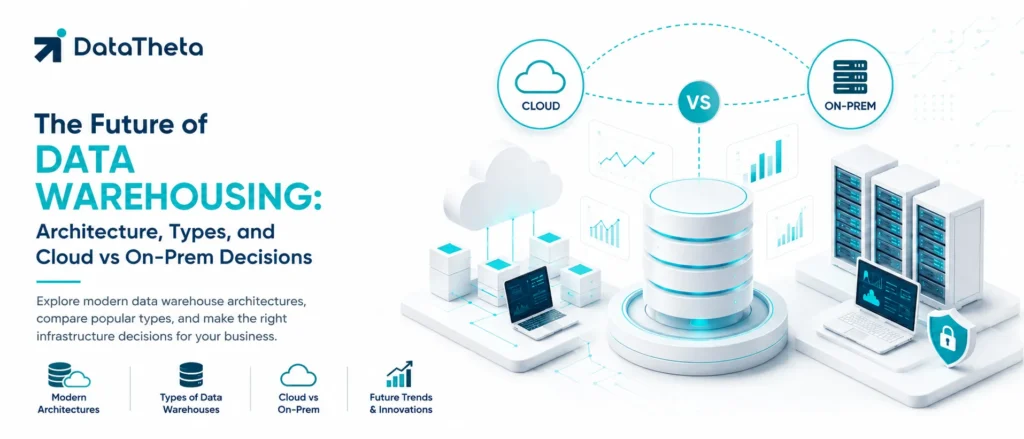
Cloud, On-Prem, or Hybrid?
Cloud data warehousing is attractive because it offers elasticity, faster setup, managed services, and easier integration with AI-native tools. It works well for variable workloads, fast scaling, and modern analytics programs.
On-premises data warehousing still matters where control, sovereignty, predictable workloads, and compliance are critical. It can also make financial sense when utilisation is steady and infrastructure is already amortised.
Hybrid architecture is becoming the practical answer for many enterprises. Sensitive or predictable workloads may remain on-premises, while scalable analytics, AI experimentation, and variable workloads move to cloud.
Decision factors include:
- Data residency requirements
- Workload predictability
- Cloud cost control
- Compliance needs
- AI and analytics roadmap
- Existing infrastructure investment
The goal is not to follow a trend. The goal is to place each workload where it performs best, costs less, and meets compliance needs.
Technologies Shaping the Future of Data Warehousing
Several technologies are becoming important in modern data warehouse architecture.
Key technologies include:
- Open table formats: Iceberg, Delta, and Hudi support more flexible lakehouse architecture.
- Semantic layers: Help maintain consistent business definitions.
- Metrics layers: Ensure teams use the same KPIs and calculations.
- Streaming and CDC: Support real-time data movement and operational decisions.
- Active metadata: Improves governance, discovery, and lineage.
- Observability: Helps monitor data quality, freshness, and reliability.
- FinOps: Controls cloud cost and consumption.
For AI readiness, these capabilities matter because models need trustworthy context, lineage, and definitions. Without them, AI can produce wrong metrics, unreliable outputs, and poor business decisions.
How Enterprises Should Modernise Data Warehousing
Data warehouse modernisation should not begin with platform selection. It should begin with business outcomes. Leaders should first identify the decisions, KPIs, and AI use cases the platform must support.
A practical modernisation roadmap includes:
- Start with business outcomes and priority decisions.
- Assess workloads, usage patterns, cost, and compliance needs.
- Classify data by sensitivity, residency, and business value.
- Choose the right architecture for each workload.
- Establish governance, ownership, and semantic definitions early.
- Pilot one priority use case end to end.
- Migrate in waves instead of using a broad lift-and-shift approach.
- Monitor cost, quality, performance, and adoption continuously.
Lift-and-shift without redesign often recreates legacy problems in a more expensive environment. Modernisation should improve decisions, not just change platforms.
Conclusion
The future of data warehousing is not defined by one platform or one deployment model. It will be shaped by well-governed combinations of warehouses, lakehouses, cloud services, on-prem systems, domain ownership, and AI-ready foundations. The warehouse is not disappearing. It is being reconsidered and rebuilt for decisions, not just dashboards.
For enterprise leaders, the winning move is not choosing the newest tool. It is choosing the architecture that supports business outcomes, governance, cost control, and AI readiness.